As John Stanley reached the prime period of his finest original series, Thirteen Going on Eighteen, in 1964, he still found time to write and re-invent licensed properties. This comic book was his last such effort until 1969.
Today's stories are typical of John Stanley the world-builder. Given a licensed character, he would extract the best aspects of that entity, discard the rest, and set up a new, better world for them to inhabit.
The John Stanley versions of Little Lulu, Tubby, Woody Woodpecker, Andy Panda, Tom & Jerry, et al, bear only visual resemblance to their official mass-media counterparts. All these characters ended up richer, more compelling and fully realized in Stanley's hands.
Only with his adaptation of George Herriman's Krazy Kat did Stanley fail to raise the bar set by the creator. Admittedly, Herriman is a tough--if not impossible--act to follow. Stanley tried hard with the Kat, and produced a compelling rethink that somewhat successfully translated Herriman's characters, settings and language to the mainstream comic book page.
Clyde Crashcup, a secondary feature on The Alvin Show, was certainly no Krazy Kat. But the character had potential for personality-based humor that was right up Stanley's alley. He championed the Quixotic, self-absorbed oddball. He genuinely enjoyed winding this figure up and letting him loose in the usually urban playground of his comics.
This was a formula of Stanley's work before the end of the 1940s, but it clearly spoke to him. He continually refined and rethought both this archetype and its place in his expansive comics world.
Crashcup's shtick is worthy of Stanley's humorous sensibilities. Completely self-absorbed, Crashcup is Barks' Gyro Gearloose turned inside-out. With great self-importance, he creates things that already exist. His voice-of-reason assistant, Leonardo, is appropriately mute--at least to us. He attempts to keep Crashcup from expending effort in creating the already-there. Lost in his own head, Crashcup ignores his voice of reason, and sees the process to its logical end. Leonardo suffers discomfort and stress, but he sticks by the wayward inventor, knowing these schemes are fated to implode.
This was Stanley's meat and potatoes--a theme which could be mined for endless variations. This harks back to Herriman, whose Krazy Kat sublimely explored this territory earlier in the 20th century. I'd love to know John Stanley's opinion of Herriman's work. To judge by his more delicate treatment of the comic-book Kat, Herriman made a big impression on Stanley. He followed Herriman's lead throughout his comics career.
Typically, Stanley would futz with a new licensed entity, uncertainly at first, get his bearings quickly, and refine both it and his process within a year. Crashcup followed this pattern. Thus, in this, the last issue of the title, Stanley has developed the simple premise of the character far beyond anything its creators cared to do, in their official version. Stanley saw the potential for comedy in places which now seem obvious, but may have been unknown, unlikely or ignored by others.
In these two stories, Stanley has relaxed into the characters, and into their place in the "normal" world that surrounds them. The Crashcup character is not a true Tubby Type (or ASS). He is an adult, and in control of his destiny. His self-esteem is ridiculously high, as is his enthusiasm. These work against him--a serial fate that Leonardo vainly tries to stave off. By including the rest of the world into the Crashcup formula, Stanley improved the simple but clever set-up of the original character, and made him an inventor of comedic chaos.
The artist for this story must have laughed and groaned in unison as he surveyed the script. Epic scenes of pandemonium pepper this story, which starts in allegro and quickly moves to capriccio.
Crashcup's ability to literalize abstract ideas sets him apart from Stanley's other eccentrics. His apparently enchanted pencil is a wand of chaos, and it has profound effects on the inventor, his assistant, and (most importantly) the world around him.
Riddled with wordplay, "Invents Hi-Fi" is among John Stanley's most energetic stories. It shows his own "magic pencil" still in top form.
This issue appropriately ends with a story about Crashcup's excitable invention of the film camera. Leonardo is rightfully worried for his life...
Bah-da-DUMP! Thank you, ladiesangentlemen, we'll be here through Thursday. The rimshot-worthy punchline, Stanley's farewell to this brief romance, is entirely apt. The risible Crashcup is just the type to invent the already-invented camera, but forget that it might need film.
Assistant Leonardo's barely contained terror, on pp. 1-2, is a too-late breakthrough. One gets the sense that, had this series continued, Stanley might have done more with this mute sidekick.
The last tier of page three offers a rare piece of social satire. It pales in comparison to this scene from Harvey Kurtzman and Will Elder's Goodman Beaver, which offers the same basic message:
Kurtzman and Elder's cynical vision of urban America appeared two years earlier, in the August 1962 issue of Help! magazine. If Stanley kept up with the cutting edge of his peers' work, he may have seen this story, and taken inspiration from this jaw-dropping Breughel-esque spread.
This points out an important difference between Stanley and Kurtzman--two of the American comic book's finest writer-artists. Kurtzman was a social satirist, a teller of hard truths (until he was gelded by Hugh Hefner), and he unflinchingly pointed out, over and over, that the emperor was naked as a jaybird.
Stanley was a light comedian, not a social satirist, and his audience was mainstream American youth. By this time, Kurtzman consciously wrote for an older crowd. Most of the "chicken fat" in this spread would have made Stanley's editors nervous and/or outraged.
It's interesting to see this same general message delivered in the pastel-hued venue of the newsstand comic book. As it is the kind of moment Stanley assiduously avoided, throughout most of his career, it brings this sitcom-story to a temporary grinding halt.
The Formula Machine soon kicks in, and the remainder of the story takes place in one of Stanley's favorite spots for urban warfare--the public park. In Stanley's work, the park, a seemingly civil place, is a free zone for his characters to lose their cool, rebel against authority, fall into life-changing danger, and come to terms with their shortcomings.
Crashcup does all but the final, most important, step. To recognize the absolute folly of his existence would shatter him into a billion brittle shards. Though this story closes the book on Crashcup, one hopes that he eventually invents Fort Knox, and retires into a comfortable life of non-invention.
It's a pity that Stanley's tenure on this book ended here. It's evident that he had just scratched the surface of the refined version of this character and his world. This unfortunate event happened over and over in John Stanley's career.
In this case, Stanley was able to channel his creative energy into the brilliant, socially dysfunctional world of Thirteen Going on Eighteen. His triumphs in that series, in 1964 and '65, are among the mainstream comic book's rare moments of perfection. I hope our friends at Drawn + Quarterly will restore the remainder of that series to print soon.
Showing posts with label the Tubby Type. Show all posts
Friday, December 2, 2011
Friday, March 25, 2011
"Adventures of Tom:" Stanley's Other Fractured Feline, from Our Gang Comics 49 and 50
I am sad to say that I'm exhausting my reserves of John Stanley material! It is a reminder of how much of his work is currently back in print--the entirety of his Little Lulu (except for the six giant-size specials of the '50s), a good deal of Tubby, all of Melvin Monster and, eventually, the remainder of Stanley's post-Lulu humorous comics.
The only open territory is the 1940s and '50s material that doesn't feature Marge Buell's properties. There's still some of that to go. That will involve some serious scanning on my part.
For today, here are two delightfully perverse stories from the "Adventures of Tom" series in Dell's Our Gang Comics. These are the last two Stanley wrote, from his short second term as the writer of "Tom and Jerry" and this feature, in 1948. (Many of Stanley's stories from this second run are posted on the blog now, including this alarming double-feature.)
By this time, John Stanley was dialed into the character of Little Lulu's Tubby Tompkins--easily the most complex and compelling figure in his comics work. Tubby's self-delusional personality, and his refusal to face reality or conform to societal expectations, rubbed off handsomely on Tom Cat. For the first and only time in the character's long mass media career, Tom was endowed with a neurotic, believable persona in these Stanley-written stories.
Tom is a hapless soul, and could benefit from some intense therapy sessions. But, like Stanley's colorful losers, he is fascinating. He does the wrongest things with the highest fervor and we sit back and watch it happen, unable to change the flawed course of his behavior.
Much like Tubby Tompkins, Tom is obsessed with an unobtainable romantic partner. Toots, a svelte white cat seen in some of the MGM animated cartoons, has him constantly crawling on his knees, in a mode of unending humiliation and torment over someone he'll never really have. He's cut short by a better-off rival, Bob Cat, who is clearly making more money than Tom, is a snappier dresser (Tom chooses to "go native" in his grey-and-white birthday suit) and a far more aggressive asshole.
In Stanley's world, the Bob Cats always get the girl. The Toms are doomed to dream and make repeated failed attempts at a prize they'll never, ever win. Does this keep them from making this conquest their life's goal? You, of course, know the answer to this question.
From OGC #49:
Tom's low social status, his cruel treatment by Toots and Bob Cat, and his near-death-by-drowning experience make this a particularly disturbing story. In anticipation of Stanley's more distanced, omniscient tone of his 1960s comics, Tom is adrift and helpless in a world that really doesn't want him around.
His poverty forces him to cut corners in his doomed romantic quest. We see him hitch a non-paying ride on a streetcar (clearly not the first time he's done this, given his familiarity with the position). More sadly, we watch him squeeze under the beachside dressing room in order to avoid the 50 cent entry fee.
Tom's almost-death scene, which occurs on pp. 4 and 5, is as intense as Stanley's horror comics of the 1960s. As he struggles to hold his breath, his tail entombed in a giant oyster shell, his mind plays out probability scenarios in which Toots and Bob are married, have children, and have clearly forgotten about Tom. Tom's enormous ego saves his life. He can't stand these thoughts, and they upset him enough to not succumb to the sleep in the deep.
This sequence, which ends with an ignoble Tom emerging from the sea, the huge oyster trailing behind him, is downright grim. He is greeted with contempt by Toots and Bob. Yes, he finds a huge pearl inside the oyster. And, yes, Toots is swayed by Tom's sudden wealth. But do you honestly think anything good will come of this?
Tom resolves to play it cooler towards Toots, as he hitches another non-paying ride home, but the writing's on the wall. We don't see the scenes that follow, but we can imagine them. Pure cartoon noir: Tom wines and dines Toots until his money runs out. When he's poor again, Toots rebounds to Bob, and Tom is again an agitated outsider.
And there's more! This remarkable (and final) "Adventures of Tom" story brings Tom's rich cognitive biases to the fore. Again, his ego drives his actions in this story, aided by his enormous fantasy life, which blurs the lines of reality for the poor addled feline.
This is another disquieting story. Some of Stanley's wittiest writing graces its dialog. Tom's "Tubby Talk" reinforces his characteristic belief that he is right in all things, and that it's obvious everyone should regard him as a brilliant, charismatic being.
Stanley shows us the dichotomy between Tom's deluded self-image and the harsh reality of his life. He prepares for an abysmally failed chat with his would-be GF, Toots, as he bubbles over with optimism, self-assurance and wit.
The call fails, and he flies into a rage. His resolve to become a hermit is simultaneously amusing and heart-breaking. Tom's inventory of his "chattel" is one of the most sublime moments in the John Stanley catalog.
His waking dream of revival, 40 years in the future, pushes the envelope of Tom's character and motivation. He sees himself almost half a century hence--bearded, toothless and cackling. He, of course, has to look up Toots, who is older, fatter, and, of course, married to Bob Cat. Tom gets an eyeful of Toots' shapely daughter and makes a Larry David-worthy decision. If you strike out with the mother, why not go for her daughter?
This is a perverse stroke of Tom's hyperbolic imagination. Of course, Tom's fantasies play out exactly like his real life. He wakes from his dream, again enraged, and returns to the real world for more suffering. The story ends on a characteristic off-note--while the conclusion is funny, it seems incomplete. Given how fragmented and frustrating poor Tom's life is, this finis is appropriate.
I don't know if Stanley knew this would be his last "Adventures of Tom" story, or if he cared. These last two installments, among the darkest of Stanley's pre-1960 work, are bracing chapters in a troubled, unhappy comic-book existence. His Tom, as I've commented before, is far more sympathetic and interesting than the Hanna-Barbera version. I can't imagine anyone allowing a modern-day cartoon character to be reshaped so darkly and carefully as is John Stanley's Tom Cat.
Well, now to get back to writing some Wacky Packages gags...
The only open territory is the 1940s and '50s material that doesn't feature Marge Buell's properties. There's still some of that to go. That will involve some serious scanning on my part.
For today, here are two delightfully perverse stories from the "Adventures of Tom" series in Dell's Our Gang Comics. These are the last two Stanley wrote, from his short second term as the writer of "Tom and Jerry" and this feature, in 1948. (Many of Stanley's stories from this second run are posted on the blog now, including this alarming double-feature.)
By this time, John Stanley was dialed into the character of Little Lulu's Tubby Tompkins--easily the most complex and compelling figure in his comics work. Tubby's self-delusional personality, and his refusal to face reality or conform to societal expectations, rubbed off handsomely on Tom Cat. For the first and only time in the character's long mass media career, Tom was endowed with a neurotic, believable persona in these Stanley-written stories.
Tom is a hapless soul, and could benefit from some intense therapy sessions. But, like Stanley's colorful losers, he is fascinating. He does the wrongest things with the highest fervor and we sit back and watch it happen, unable to change the flawed course of his behavior.
Much like Tubby Tompkins, Tom is obsessed with an unobtainable romantic partner. Toots, a svelte white cat seen in some of the MGM animated cartoons, has him constantly crawling on his knees, in a mode of unending humiliation and torment over someone he'll never really have. He's cut short by a better-off rival, Bob Cat, who is clearly making more money than Tom, is a snappier dresser (Tom chooses to "go native" in his grey-and-white birthday suit) and a far more aggressive asshole.
In Stanley's world, the Bob Cats always get the girl. The Toms are doomed to dream and make repeated failed attempts at a prize they'll never, ever win. Does this keep them from making this conquest their life's goal? You, of course, know the answer to this question.
From OGC #49:
Tom's low social status, his cruel treatment by Toots and Bob Cat, and his near-death-by-drowning experience make this a particularly disturbing story. In anticipation of Stanley's more distanced, omniscient tone of his 1960s comics, Tom is adrift and helpless in a world that really doesn't want him around.
His poverty forces him to cut corners in his doomed romantic quest. We see him hitch a non-paying ride on a streetcar (clearly not the first time he's done this, given his familiarity with the position). More sadly, we watch him squeeze under the beachside dressing room in order to avoid the 50 cent entry fee.
Tom's almost-death scene, which occurs on pp. 4 and 5, is as intense as Stanley's horror comics of the 1960s. As he struggles to hold his breath, his tail entombed in a giant oyster shell, his mind plays out probability scenarios in which Toots and Bob are married, have children, and have clearly forgotten about Tom. Tom's enormous ego saves his life. He can't stand these thoughts, and they upset him enough to not succumb to the sleep in the deep.
This sequence, which ends with an ignoble Tom emerging from the sea, the huge oyster trailing behind him, is downright grim. He is greeted with contempt by Toots and Bob. Yes, he finds a huge pearl inside the oyster. And, yes, Toots is swayed by Tom's sudden wealth. But do you honestly think anything good will come of this?
Tom resolves to play it cooler towards Toots, as he hitches another non-paying ride home, but the writing's on the wall. We don't see the scenes that follow, but we can imagine them. Pure cartoon noir: Tom wines and dines Toots until his money runs out. When he's poor again, Toots rebounds to Bob, and Tom is again an agitated outsider.
And there's more! This remarkable (and final) "Adventures of Tom" story brings Tom's rich cognitive biases to the fore. Again, his ego drives his actions in this story, aided by his enormous fantasy life, which blurs the lines of reality for the poor addled feline.
This is another disquieting story. Some of Stanley's wittiest writing graces its dialog. Tom's "Tubby Talk" reinforces his characteristic belief that he is right in all things, and that it's obvious everyone should regard him as a brilliant, charismatic being.
Stanley shows us the dichotomy between Tom's deluded self-image and the harsh reality of his life. He prepares for an abysmally failed chat with his would-be GF, Toots, as he bubbles over with optimism, self-assurance and wit.
The call fails, and he flies into a rage. His resolve to become a hermit is simultaneously amusing and heart-breaking. Tom's inventory of his "chattel" is one of the most sublime moments in the John Stanley catalog.
His waking dream of revival, 40 years in the future, pushes the envelope of Tom's character and motivation. He sees himself almost half a century hence--bearded, toothless and cackling. He, of course, has to look up Toots, who is older, fatter, and, of course, married to Bob Cat. Tom gets an eyeful of Toots' shapely daughter and makes a Larry David-worthy decision. If you strike out with the mother, why not go for her daughter?
This is a perverse stroke of Tom's hyperbolic imagination. Of course, Tom's fantasies play out exactly like his real life. He wakes from his dream, again enraged, and returns to the real world for more suffering. The story ends on a characteristic off-note--while the conclusion is funny, it seems incomplete. Given how fragmented and frustrating poor Tom's life is, this finis is appropriate.
I don't know if Stanley knew this would be his last "Adventures of Tom" story, or if he cared. These last two installments, among the darkest of Stanley's pre-1960 work, are bracing chapters in a troubled, unhappy comic-book existence. His Tom, as I've commented before, is far more sympathetic and interesting than the Hanna-Barbera version. I can't imagine anyone allowing a modern-day cartoon character to be reshaped so darkly and carefully as is John Stanley's Tom Cat.
Well, now to get back to writing some Wacky Packages gags...
Labels:
romance,
Stanley in the 1940s,
the Tubby Type,
Tom And Jerry
Wednesday, July 14, 2010
Stanley Does "Doody"--Infuses Stale Puppet, Sidekicks With Energy (Selections from Howdy Doody 4 and 7, 1950/1)
This is the last place I'd ever think to look for John Stanley material. Yet here it is. Stanley certainly kept busy in the 1940s and '50s.
As Howdy Doody was among the most popular early television series, it made sense to merchandise the daylights out of it--including a Dell comic magazine that ran 38 issues.
The Overstreet Price Guide claims this was the first comic book based on a TV series. As the show was broadcast live from NBC's New York facilities, it makes sense that the comic book version would be assembled and created in The Big Apple as well.
Like Marjorie Buell, Little Lulu's creator, "Buffalo" Bob Smith, host and originator of the Doody phenomenon was protective of his creations. I don't know if Smith exercised the same initial hands-on participation in the Dell Doody comic, but its East Coast roots might suggest a close-to-home attitude by all parties concerned.
At this time, Stanley's writing had lost a bit of its edge. This is evident in his Little Lulu comics of 1949 and 1950. The end of the 1940s is a transitional phase for John Stanley, in which he perhaps sought to step away from the frantic antics that typify his earlier work.
Perhaps also influenced by the mellower aspects of Marge Buell's Lulu universe, in which slapstick is a rarity, Stanley has a period of almost eerie calm in his work of this period--particularly the comics published in 1950. (A prime example of this hushed Stanley mood is the first issue of Henry Aldrich, from '50. It plays like Thirteen Going On 18 on heavy sedatives.)
The urge to create wild physical comedy, adorned with gaudy SFX and excitable dialogue, still manifests in Stanley's non-Lulu work. Alongside his Krazy Kat comics of 1951/2, the Howdy Doody stories are lesser works that brim with manic energy.
The brassy verbal humor of the later 1950s is nowhere in sight. These Doody comics may have been consciously written for a younger audience. They're not as smart, nor as subtle, as Lulu or the first Henry Aldrich comic. They abound with Stanley "tells."
Consider this sequence, from the opening of the first story in Howdy Doody #4:
"Howdy... I'm worried..." Right there is the odd essence of John Stanley's writing. The expression of darker emotions, coupled with the dramatic pause of the ellipses...
In the Dell version, Doody is not a marionette; nor are his cohorts. They're living beings who engage in mundane and fantastic adventures, with predictably mixed results. Stanley seems less interested in his protagonists, Howdy and Dilly Dally, and more invested in the second-stringers, such as Clarabell the clown, the apoplectic Mister Bluster and, most vividly, the what-the-hell-is-it called Flub-a-Dub.
Stanley endows FAD (I'm not going to type that name over and over!) with some strong Tubby Type characteristics. Two FAD stories, from issues 4 and 7 of the series, show the same self-centered world-view, the cognitive bias-driven agenda, and the inability of the TT to recognize him/her/itself as eccentric, out of step with the rhythm of the regular world.
The secondary figures are usually free of the constrictions imposed upon the stars. Here's where Stanley cuts loose and has some fun with yet another licensed property...
This could be a New Funnies story from a few years earlier. FAD falls someplace between Stanley's Woody Woodpecker and Tubby in its combo of aggression and self-absorption. Yet, because of the close-knit nature of the Doody cast, FAD is not a pariah (rather like Tubby). FAD is an interesting variant on the Stanley "Tubby Type."
Issue 7's FAD story brings aboard the entire Doody cast for a frenzied snow fight-cum-status battle.
This antic story teems with energy, in a situation familiar to any reader of Little Lulu or Tubby.
Ditto for this "Dilly Dally" story, also from Doody #7.


* * *
As Howdy Doody was among the most popular early television series, it made sense to merchandise the daylights out of it--including a Dell comic magazine that ran 38 issues.
The Overstreet Price Guide claims this was the first comic book based on a TV series. As the show was broadcast live from NBC's New York facilities, it makes sense that the comic book version would be assembled and created in The Big Apple as well.
Like Marjorie Buell, Little Lulu's creator, "Buffalo" Bob Smith, host and originator of the Doody phenomenon was protective of his creations. I don't know if Smith exercised the same initial hands-on participation in the Dell Doody comic, but its East Coast roots might suggest a close-to-home attitude by all parties concerned.
At this time, Stanley's writing had lost a bit of its edge. This is evident in his Little Lulu comics of 1949 and 1950. The end of the 1940s is a transitional phase for John Stanley, in which he perhaps sought to step away from the frantic antics that typify his earlier work.
Perhaps also influenced by the mellower aspects of Marge Buell's Lulu universe, in which slapstick is a rarity, Stanley has a period of almost eerie calm in his work of this period--particularly the comics published in 1950. (A prime example of this hushed Stanley mood is the first issue of Henry Aldrich, from '50. It plays like Thirteen Going On 18 on heavy sedatives.)
The urge to create wild physical comedy, adorned with gaudy SFX and excitable dialogue, still manifests in Stanley's non-Lulu work. Alongside his Krazy Kat comics of 1951/2, the Howdy Doody stories are lesser works that brim with manic energy.
The brassy verbal humor of the later 1950s is nowhere in sight. These Doody comics may have been consciously written for a younger audience. They're not as smart, nor as subtle, as Lulu or the first Henry Aldrich comic. They abound with Stanley "tells."
Consider this sequence, from the opening of the first story in Howdy Doody #4:
"Howdy... I'm worried..." Right there is the odd essence of John Stanley's writing. The expression of darker emotions, coupled with the dramatic pause of the ellipses...
In the Dell version, Doody is not a marionette; nor are his cohorts. They're living beings who engage in mundane and fantastic adventures, with predictably mixed results. Stanley seems less interested in his protagonists, Howdy and Dilly Dally, and more invested in the second-stringers, such as Clarabell the clown, the apoplectic Mister Bluster and, most vividly, the what-the-hell-is-it called Flub-a-Dub.
Stanley endows FAD (I'm not going to type that name over and over!) with some strong Tubby Type characteristics. Two FAD stories, from issues 4 and 7 of the series, show the same self-centered world-view, the cognitive bias-driven agenda, and the inability of the TT to recognize him/her/itself as eccentric, out of step with the rhythm of the regular world.
The secondary figures are usually free of the constrictions imposed upon the stars. Here's where Stanley cuts loose and has some fun with yet another licensed property...
This could be a New Funnies story from a few years earlier. FAD falls someplace between Stanley's Woody Woodpecker and Tubby in its combo of aggression and self-absorption. Yet, because of the close-knit nature of the Doody cast, FAD is not a pariah (rather like Tubby). FAD is an interesting variant on the Stanley "Tubby Type."
Issue 7's FAD story brings aboard the entire Doody cast for a frenzied snow fight-cum-status battle.
This antic story teems with energy, in a situation familiar to any reader of Little Lulu or Tubby.
Ditto for this "Dilly Dally" story, also from Doody #7.


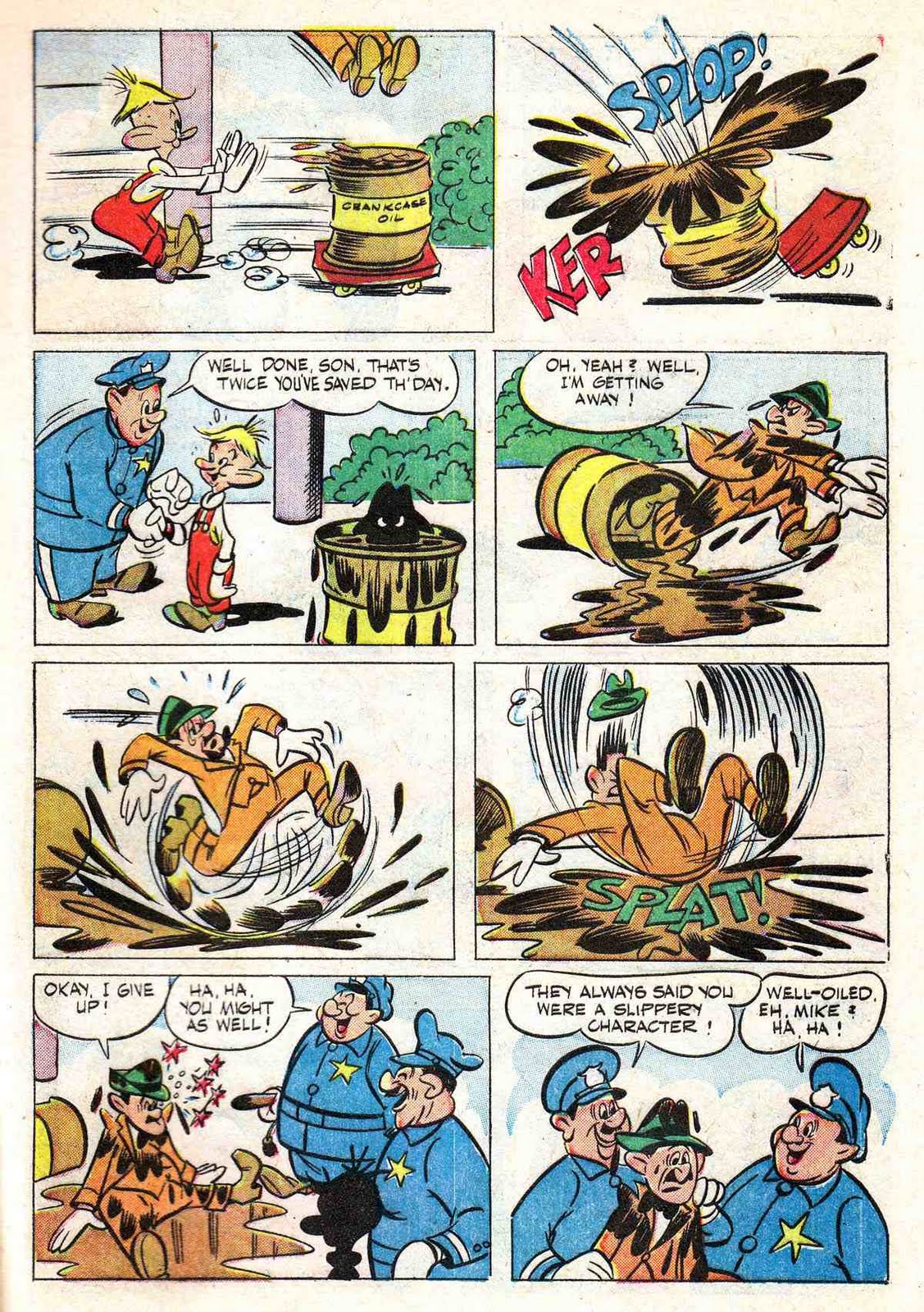
"Service with a Smile" uses a standard Stanley set-up: well-intentioned doofus is entrusted with the management of an important business. Said doofus seemingly effs up every chance to succeed, as event piles atop calamitous event. The totality of the failures adds up to an ironic twist of positive fate. Underdog comes out smelling like roses, to the consternation of the gelded authority figure who is the catalyst of the chain of events.
Stanley uses this plot in several of his Walter Lantz-character stories, and in the Little Lulu titles. (This plot shows up in one of his last LL stories of 1959. I'll soon run a special series here called "The Last of Stanley's 'Lulu,' featuring highlights from the final four issues of his long run on the series.)
This hardly seems the proper place to say this, but I'm still stunned by the recent passing of Harvey Pekar. I recently spoke to Harvey, about a month ago, in which I conducted a 90-minute interview with him. This may be the final interview he gave. This interview was conducted for an upcoming column I hope to do for an internet comics website in which I discuss, with comics creators, how they do their work.
Pekar spoke with frankness about the low pay he received for his work, and seemed, in general, resigned to non-retirement, as he felt he had to produce work in volume, rather than pieces of high quality, to pay the bills.
These were sobering comments about the comics industry. I'm not sure they're appropriate for the column--or, if, indeed, it's tasteful to run the interview any longer. This blog, certainly, is not the forum for the interview. I haven't transcribed it yet.
Given Pekar's passing, and his tremendous importance to the development of the comics form towards more honest, real material, I think it's of some value. Jury's still out on this, but I hope to offer it to the world sometime soon.
Harvey Pekar was a unique writer, intellect and personality. As many others have said, via his stories, I felt like I knew him personally. I can't say that about too many comics creators.
Pekar spoke with frankness about the low pay he received for his work, and seemed, in general, resigned to non-retirement, as he felt he had to produce work in volume, rather than pieces of high quality, to pay the bills.
These were sobering comments about the comics industry. I'm not sure they're appropriate for the column--or, if, indeed, it's tasteful to run the interview any longer. This blog, certainly, is not the forum for the interview. I haven't transcribed it yet.
Given Pekar's passing, and his tremendous importance to the development of the comics form towards more honest, real material, I think it's of some value. Jury's still out on this, but I hope to offer it to the world sometime soon.
Harvey Pekar was a unique writer, intellect and personality. As many others have said, via his stories, I felt like I knew him personally. I can't say that about too many comics creators.
Labels:
Howdy Doody,
Stanley in the 1950s,
the Tubby Type
Subscribe to:
Posts (Atom)