Sunday, July 12, 2009

Even More 1957 Summer Camp Little Lulu: part 2

Hi, gang! This time I've made sure all the pages are here, so read without fear.

Here's part two of the 1957 Little Lulu summer camp giant.

First up: "Too Many Buglers," a triangular tale of one-upmanship, graced with masterful comedic dialogue and constant action.


Stanley's writing is razor-sharp in "Too Many Buglers." This long story is stuffed with one comedic incident and witty line after another. Alvin, often the wild-card member of the Little Lulu troupe, screws things up royally in his naive bliss.

The sequence of the kids running, en masse, from one interrupted activity to another, due to the errant bugling, is high-quality sitcom. And the counsellor's exclamation, on the story's last page is priceless: "The red-blooded daily doings of Camp Tiny Tot... led by a kazoo?"

And how about that group "CHOFF?" Plus the most perfect SFX for wet clay hitting a cement floor... "SPAT!" (And delivered in a word balloon--an essential Stanley "tell.")

Tubby stars in "Flag-Raising Practice." I'll say no more 'til you've read this story...


Whew! That was a comix decathelon--a beautifully achieved comedy of escalating troubles. Every thing Tubby does makes the situation worse, until his Space Age deus ex machina, the little men from Mars, appear.

Their appearance would seem contrived, save for their reports of the alterations to Tubby's room at home--a lovely little grace note that helps to gloss over the abruptness of their arrival.

Tubby is doing fine without them. From his self-absorbed actions of page one, ending with a priceless line of self-justification, to his frantic activity (decorated by stellar SFX by Stanley), to his panic as the boat unmoors, then develops a leak (from his manic stomping), young master Tompkins is at his best here.

I'm struck by what funny pieces we have here. Each and every story, so far, has hit a humorous home-run. No corners are cut, and what might be a deluge of information, in other hands, becomes a cornucopia of comedic decoration.

Let's see what's next. I'm reading these for the first time as I create this post...


"The Fourth" is as close to a throwaway story as we'll get here. It's light-years beyond mere filler, due to the gleeful melding of many essential ingredients:

a) Tubby's gluttony
b) Lulu's stubborness
c) the girls' demonstration that they can be just as uncouth and self-centered as the boys

I can't recall Lulu biting one of her friends anywhere else. Or perhaps I've overlooked such behavior up 'til now...

I love that Tubby actually does find another ice-cream cup at story's end. Stanley forever favors his anti-heroes. Altho' he puts them through rigorous paces, they usually get what they want, no matter how "right" or "wrong" that desire may be.

Moral ambiguity in a "wholesome" summer camp comic book... what's not to like about that?

Part Three in a day or so...

Saturday, July 11, 2009

Even More Little Lulu Summer Camp Shenanigans! (pt. 1--MISSING PAGES FIXED!)

Times are tough all over: that's the sense I got from my previous post. Thanks to the two kind souls who responded. Look for super-cool news involving one of these kind individuals very soon!

But it's also summer, and that means it's time for another Little Lulu-at-summer camp shindig!

I recently located this first LULU summer-camp giant. It's new to me, and it's a pleasure to present it to you.

I don't have much to say that I haven't said before about these summer camp giants. They follow an established formula. The formula works because the characters are invested with great personalities and quirks. These quirks continually up the narrative stakes, and fuel the stories.

What might be paint-by-numbers, mind-numbing blandness in most hands becomes vivid, humorous, consistently rewarding material a la John Stanley.

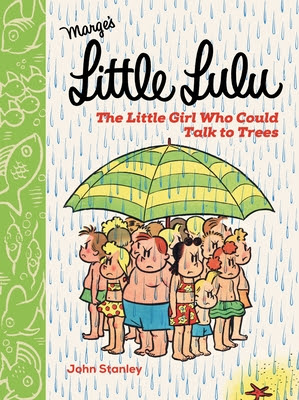
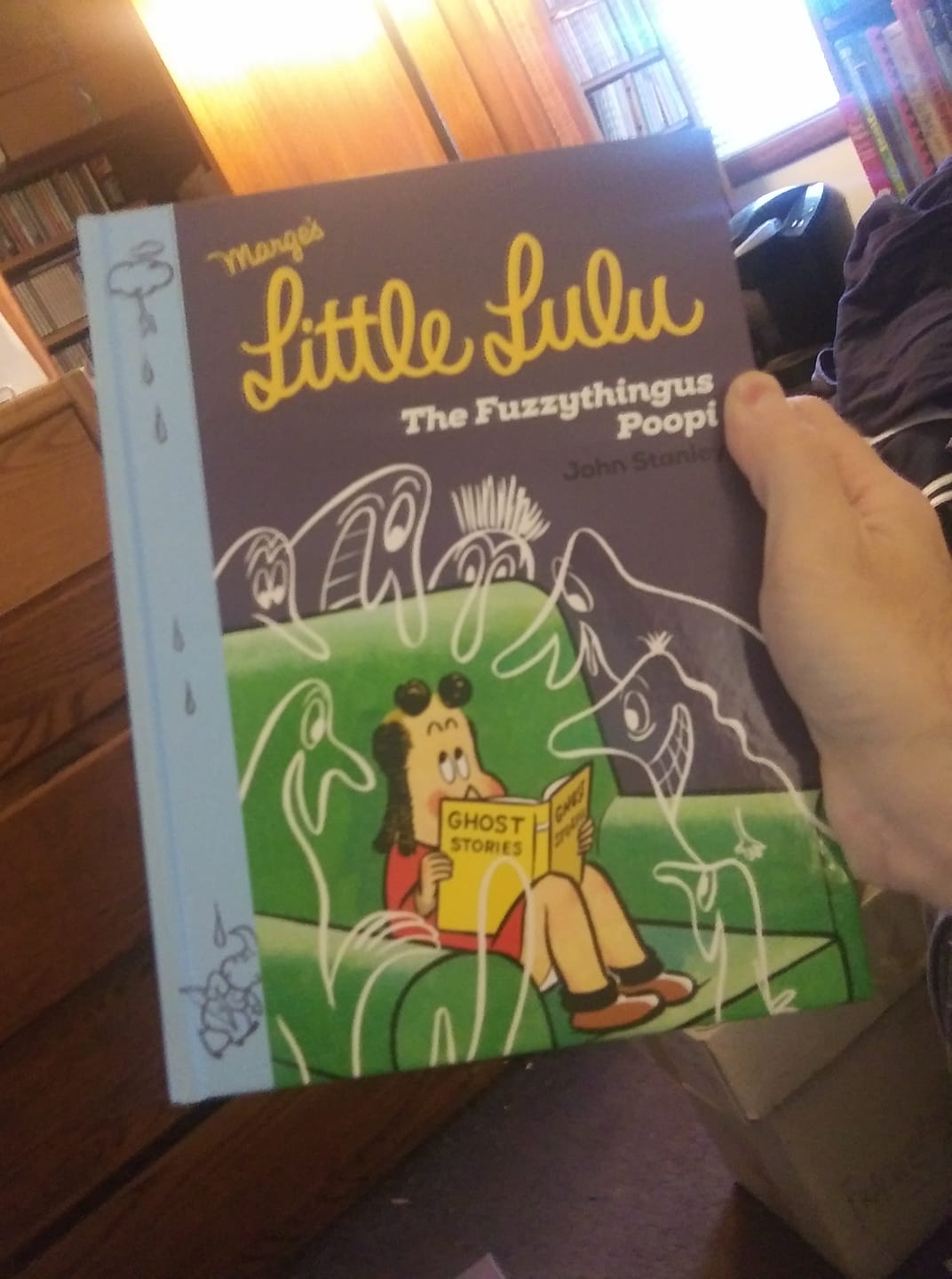
Foist things foist... here's the cover--unusual for Stanley comix, it's painted, in that delightfully creepy '50s storybook-moderne style. Sootable fer framin'!


Here are the first three stories from this 100-page book. I'll keep posting the stories 'til it's all complete.

The opening story offers a novel variant on the typical summer-camp-giant introduction. "The Big Frame-Up" is a highly charged piece of writing. Stanley captures the tension of childhood friendships here with a keen eye.

[A note to those who tried to read this story before today: oops! Yow! Sorry for the missing pages... I somehow missed them. Here they are now. Please re-read this story...]


Tubby is rightfully paranoid in this story. Like a film noir protagonist, he's hounded by pre-determined, inexorable fate. At the end, when it's revealed that Lulu and Tubby's mother have conspired in this large-scale erosion of Tubby's freedom of choice, Tubby is righteous in his indignation.

This comedy of antagonism is also a comedy of invasion. Tubby can't compete with Lulu's keen wit--perhaps that's the rub for him... she's trumped him yet again, despite his high self-opinion.

Darn it! I said I wasn't going to say anything, but I can't control myself...

"Bushopper" is a brilliant Tubby solo piece in which his stubbornness and self-absorption creates 20 shades of trouble--all of them inventive and amusing.


Stanley's wit is subtle here, and I appreciate that he respects the reader's intelligence in his staging of events. It's especially impressive when one considers that the target audience for these comix were grade-school kids.

Stanley must have known, or sensed, that adults read these comix as well. Lulu wasn't a top seller just from childhood purchases. Friends of mine who grew up in the 1950s recall their parents regularly reading Little Lulu, without shame or subtext; one person remembers his mother buying it every month, alongside Family Circle, Redbook, Collier's and other coffee-table staples of post-war America.

Whatever his motivation, Stanley's was the gift to write for young and adult readers, and offer something of value to both--without condescending to one or the other.

In "The Guilty One," Tubby completely falls apart. I'm struck by the richness of Stanley's writing here, and how deeply invested he is in every character.

And, as Thad pointed out, check out the decorations on the tepees on page 19! Er, um, uh... I know that was a Native American symbol before a certain hatemonger adopted it for his ill-fated Evil Empire. Still, it was the late 1950s, and people surely had that icon fresh in their collective memory...


"I'll wear the mask of a normal human bean! I'll put on a care free smile! I'll lose myself in the milling crowd!" Tubby is at his finest in this story.

As well, the boys' interactions, and how they turn on Tubby, and ostracize him, rings true. It imbues the story with tragicomedy that builds. "The Guilty One" approaches the tension of an EC "SuspenStory" while never forsaking the fundamentals of the Lulu universe.

More soon--maybe even tomorrow, if I can get up early enough...

Wednesday, July 8, 2009

Got Any Work That Needs Doing?

I'm reluctant to do this, but times are really bad right now for me.

Bad as in "no food to eat" bad. Bad as in "can't pay my rent" bad.

I'm owed money by a couple of major publishers. Alas, their wheels grind at an agonizingly slow pace. It will be at least the end of July before I see any payment from them.

In the meantime, I'm completely broke. I think my bank balance currently sits at -$1.00. (Truth be told, I'm afraid to look anymore)

I don't have any friends or family that I can call on for help.

But I am able-bodied, talented in many areas, and available for freelance work.

Please check out my resume-blog at http://fmycreative.blogspot.com/.

I have 30 years' experience as a writer and graphic designer.

If I can be of any service to you, please contact me and let me know.

I've applied with local creative temp agencies, but heaven knows when that will pan out, work-wise. All my local work sources are too hard-hit by the depression to offer me any work.

This is a long shot, but I'm screwed right now and I need to do something. Thanks for taking a moment to read this. I hope the current "economic downturn" (ha! ha! ha!) is giving you a better deal than I'm experiencing at present.

Thanks again,
Frank Young

Sunday, July 5, 2009

Don't Mess With the One-eyed Wobblies: from Raggedy Ann and Andy #32, 1949

Are you ready for this? Because if you're not, I feel hesitant to put this story on the table. Get a cup of coffee, make yourself comfortable, take a deep breath, and read this:


Wow...


This is the ideal John Stanley mix of dark and light. The contrast of the title characters' cheery, mischevious, naive nature, and the embodiment of unseen but deeply felt terror that pursues them is stunning and haunting.

This is one of Stanley's most authentically dream-like stories. In this piece, he masterfully tapped into subconscious veils of primal fear, and the matter-of-factness of dream logic. All the elements are there: the deep, dark woods; a menace that is well-known but never clearly seen; random acts of mischief that engage the menace into pursuit; and, finally, a deus ex machina device that the characters regard as commonplace. It's here, and we know how it works, so let's use it, and see where it takes us.

Again with the large objects rising and descending! We just encountered this motif in "The Mighty Mites," and, of course, in "The Guest in the Ghost Hotel." The push-button elevator island is one of the most imaginative moments in John Stanley's career.

It's a perfect touch that the Raggedies don't make a big deal out of this dreamscape set-piece. It's a means to an end, and it rescues them from the One-Eyed Wobblies (who wouldn't really have a beef with them, had Andy not thrown sand in their eyes...)

That's another beautiful moment in this story--the childish provocation of the unseen threat. It's like a kid throwing rocks at a hornet's nest, or poking holes in an ant-bed. It's a very natural kid thing to do--an action that connects vividly with the reader, who has done (or will do) such things throughout their lives.

Stanley's language is a delight in this story, as well. After the incident with Andy getting lost in a tree, Ann begins to freak out. The nonchalant Andy tries to reassure her. Ann replies with an answer that logically sums up the crisis they face:

That is beautiful writing--it cuts to the heart of the matter, and expresses fear in colloquial kid-speak.

The Raggedies are perfect protagonists for John Stanley. They're non-entities which can be dropped into any situation. I like how unfazed they are by being plunged into the depths of the body of water (lake? ocean?) via the elevator-island. I suppose that, being sentient dolls, they need no oxygen intake. They can be plopped into any locale (the moon, Hades, Nebraska). All they have to do is act and react: instant story!

Stanley's writing lost much of this spontaneous vibe from the late '50s onward. His imagination didn't cease to function; I think his priorities as a storyteller shifted. He seeks firmer ground at all times, even when, as in the Yo-Yos stories of Nancy and Sluggo, his protagonists are pitched head-first into a nightmare world. Stanley strives to clearly isolate dream-logic events and conscious experiences in his later work.

I'm very fond of the dream-state he achieved in stories such as this and "The Guest in the Ghost Hotel." I am never quite sure if these stories' events are "real" or "dream." John Stanley was really onto something with this vein of stories. I wish he'd done more of these, but I'm grateful for those that exist.

Thanks to art spiegelman for tipping me off to this story's existence. I'm glad I finally found it, and can share it here.

Saturday, July 4, 2009

The Tragicomic Debut of Peterkin Pottle: Raggedy Ann & Andy #32, 1949

Fireworks make me uneasy, and hot dogs make me queasy, so here's my way of sellybratin' the 4th with you! (Truth told, I'm going to a 4th soiree that promises to have both hotdogs and fireworks. I'll do anything for a clever opening sentence!)

Here is the long-sought debut of Stanley's first original character for the comic books: Peterkin Pottle.

He rated a significant fanfare for Raggedy Ann and Andy. They re-did the logo, and gave Peterkin a memorable front-cover send-off. Speaking of which...


Ad per the new house policy, no yakkin' from me 'til after the story. I apologize for the spectacularly poor printing job Western Publ. and Litho. did for this story. Could those reds be anymore off-register? It detracts from one's appreciation of Stanley's cartooning grace. Said grace, and complementary verbal wit, still shine through strongly...


Wow... a sweet, charming ending! This story may surprise those Stanleyphiles who groove to the harsher, darker, mean-streets side of our hero's writing. Indeed, this maiden voyage of Pottle differs from subsequent episodes in several ways.

From the start, poor Peterkin's fate as alienated schlub is set in stone. When reading this story, I had the sudden realization that, via Peterkin, Stanley got a handle on the character of Tubby Tompkins, from his million-selling Little Lulu comix.

Before PP, Tubby is a more generic wise-guy character, all bluster and little or no neurosis. In "Pottle"'s wake, Tubby gains some of Peterkin's psychological profile. By writing and drawing this feature, Stanley got the elements that made Tubby the most fascinating member of Lulu's dramatis personae.

Peterkin anticipates some of Tubby's classic self-absorption in the fantasy sequence. Peterkin's intro as the hero is handled with sublime understatement. As with Tubby, Peterkin is, in his own mind, the cool/calm/collected master of his universe... able to leap tall buildings in a single bound, etc., etc., etc.

This discrepancy between Peterkin's inner world, and the harsh reality of real life, becomes a core of Tubby's persona in the 1950s. This is a classic Stanley anti-hero trait. Woody Woodpecker displays this same flight from reality in several of his Stanley-authored stories.

Altho' Peterkin is immediately subject to neighborhood cruelties, he seems less malformed--and more misunderstood/sympathetic--than he'd be in later episodes. Indeed, the improbably touching wrap-up is unique to this series.

I prefer Stanley with dark and light interwoven, as in this story, and as in the best Lulu stories. "Pottle" gets amazingly grim and harsh in its later episodes. There's a Walter Mitty-ish aspect to Pottle, in this story, that is lessened as the series rolls on.

Stanley's darkness is so intense, and so effective, that it can be hard for me to take. I think it reminds me a little too much of my own troubled childhood (heck, let's make that adulthood, too, while we're at it).

My unease at the dark side of John Stanley is a testament to his effectiveness in that regard. He could get under the reader's skin, and dig into the nerve center, while ostensibly serving up a souffle of "kiddie komix" a la Dell.

Note that Stanley illustrates this story with pen and ink. He switched to brush for later Pottles. Stanley got great with the brush in his 1960s comix. He was much stronger with the nib in the '40s and '50s.

This is beautiful cartooning--dig those animals, for example! Tigers, elephants, rhinos, gorillas, lions--all rendered with impressive grace and style! Stanley's lumpen human figures contrast strinkingly with the bold, expressive images of animals. That tiger on p.3, panel 4 is spectacular cartooning!

Western Publ. and Litho. were idiots not to realize--and exploit--Stanley's talents as a "name" cartoonist, as they did with Walt Kelly. Small wonder Stanley became embittered in later years. He (and Barks) got a raw deal in the long run.

At the time, as they did their greatest work, both creators were given a great deal more free room than most of their comix colleagues. Imagine a Barks or Stanley working for DC, or Timely...no, I take that back. I can't imagine it.

Creative freedom vs. public acclaim... a few fortunate comic book creators (Jack Cole, to name one) had both, but the combo proved most elusive and rare.

Come back tomorrow, as I've got yet another treat for you--from this same funny-book! Yow!

Enjoy today's hot dogs, watermelon, numerous beers, fireworks, and traffic jams! Drive safely and responsibly--I want to see you all here tomorrow!

Friday, July 3, 2009

Oswald the Rabbit and The Easter Party; Four-Color #183, 1948

Here's another 32-page Stanley story from 1948--one that is, to my best knowledge, new to the Internet. These are my scans.

Read, enjoy, and then we'll talk...


<*><><*><><*><><*>


Three persistent second-string Stanley themes merge in this story: the all-powerful, manipulative rich, evil midgets posing as children, and magicians.

All of these themes surface in Little Lulu and Nancy from time to time. It's notable to find all three in one story.

Less plot-driven than most of Stanley's book-length stories, "Easter Party" has an engagingly loose, spontaneous feeling. I don't think Stanley spent much time or effort in writing it.

The anonymous artist was not among Western Publishing's finer craftsmen. His work appears in New Funnies during that title's Stanley period. The boldness and agitation of his figures may stem more from Stanley's layouts. His actual drawing leaves much to be desired. The lack of polish hurts the story overall.

Stanley's protagonists, as here, are usually under-priveliged: in need of money or security. The rich, always a symbolic figure in the Stanley universe (and usually sinister in nature), serve as a temporary open door to a better world.

The Van Doughs are, as Stanley's rich go, benevolent--if self-absorbed and presumptuous. At story's start, Mrs. Van Dough stalks Oswald and his domestic partner, Toby, through a department store. She demands Oswald's presence at her son's party. To her view, he has nothing better to do, being a mere peasant.

Unlike the rich families of Lulu and Nancy, the Van Doughs are seemingly kind people. Stanley's dislike of the rich never lets the reader feel comfortable in such refined surroundings. There is always an element of threat.

In this story, the threat comes in the form of a masquerading midget who impersonates the Van Doughs' wussy son, Algernon. Mrs. Van Dough notices that her formerly benign son is now a grade-A asshole, but assumes it's just a phase he's going through. She has garden parties and croquet matches to think about. She is also (ahem) nearsighted. This is the perfect ailment for a wealthy Stanley character. It's also the lynchpin of the story's wafer-thin plot.

No Mr. Van Dough is seen. Makes one wonder, as Stanley typically has his wealthy married and settled. Perhaps he was a casualty of the Great Funny-Animal world war--erased before his time.

The centerpiece of "The Garden Party" is a lengthy battle-of-wits between Os and Toby and the faux-Algernon. The mean-spirited, larcenous fake Algy does his best to publicly humiliate and confound our heroes as they blunder their way through an improvised magic act.

This section of the story reads like a storyboard for an animated cartoon. It shows Stanley's cleverness and resourcefulness. Such a sequence would be tedious in most funny-animal comix. Like Carl Barks, Stanley had an understanding of formulae, and how to confound them.

The breezy grace of this long sequence is unique in Stanley's work. It's refreshing to see him let go of the narrative, and just let amusing things happen, one after another.

The magic act is a perfect set-up for these seemingly spontaneous events. Poor, bland Oswald is given quite an honor; the magician is a special figure in the Stanley universe. Whether a stage conjurer, or an actual wizard-type (e.g., Uncle Eek in Nancy), the magician enjoys a special status.

It's a kind gesture to Oswald, who had been abandoned as a screen character after the 1930s. Stolen from Walt Disney in the late 1920s, Oswald was continued, after a brief transitional period, by Walter Lantz's animation studio.

The Oswald cartoons of the pre-code talkie era are imaginative, freaky things. A young Fred "Tex" Avery was on the Lantz staff at the time, and certain cartoons from 1930-1934 show his developing sense of humor.

Oswald followed the blanding trend of Mickey Mouse as the '30s staggered on. His newfound wimpiness proved his undoing. A cuter, cuddlier, less dangerous character runs out of things to do. Oswald was quietly dumped at the end of Lantz's 1938 cartoon season.

He was revived for one mediocre musical cartoon in 1943. Though he appeared on Lantz-made TV shows in the 1960s, his career as a screen star was kaput. He was used in merchandising and licensing. Early TV reruns of his Lanta cartoons may have revived his marketability in the late 1950s. His last funnybook appearance was in 1962.

You can see some of Oswald's animated antics on DVD: Disney put out a two-disc set of all the surviving silent cartoons. Selections from the talkie Lantz era are on the two sets of Woody Woodpecker and Friends, also indispensible for the cartoons directed by James Culhane.

Oswald was also among the first licensed characters for the funny-books, via his February, 1935 appearance in the first issue of New Fun Comics. an early effort of the company soon known as DC,

There you go: all the Oswald Rabbit factoids you didn't think you needed to know. Well, now you do. And, now--adieu!

Friday, June 26, 2009

A Nightmarish SF Epic, Starring Andy 'n' Charlie: The Mighty Mites, "Four Color" #198, 1948

Remember "The Secret Six," the intense, ultra-dark Oswald Rabbit story from 1945? (It was posted here last year--well worth the effort to locate, if you've got the time.)

Here is its twin--one of John Stanley's final "Four Color" books featuring the Walter Lantz characters. "The Mighty Mites," from late 1948, is devoid of all but the darkest, dryest black humor.


Loaded with Stanley "tells"--floating eyes in blackness, morbid themes (including a jaw-droppingly grim finale, made all the darker for its casual, conversational delivery), ZAZzes galore, windmill action, SFX in speech balloons--"Mighty Mites" may qualify as the darkest Stanley Story of the 1940s.

Grim as "The Secret Six" is, it's leavened with light comedy, and trades on the sexual ambiguity of Oswald Rabbit and his domestic partner, Toby Bear.

Fellow dompars Andy Panda and Charlie Chicken have no time for comedy in this breathless, EC-like intense story of a mad scientist, living alone in a rambling house out in the middle of nowhere.

It starts on a dark and stormy night... well, take 15 minutes and just read this thing. Then we'll talk...


Morgan is one hell of a disturbing villain. He has no motivation for his actions. Sure, one of his victims mentions that Morgan wants to be "king of the world," but his scheme of shrinking every being on the planet to "four inches--or SMALLER!" would take several lifetimes. There would have to be chartered busses bringing large groups of people around the clock, for years and years, for Morgan to attain his dark goal.

What chain of events led him to (a) develop the shrink-ray and (b) lure unsuspecting chumps into his remote forest home, whereupon he (c) shrinks them and collects them in bird cages while (d) actually believing he can rule the entire world?

In the best tradition of sociopathy, Morgan's outward persona is bland, ineffectual and even cordial. Although everything about his homestead screams WARNING! PSYCHOTIC LOSER! AM-SCRAY!, etc., his apparent affable, cheery facade disarms his victims.

This isn't the first time Stanley has invested the villain of a story with more interest than its alleged heroes. In this case, bland, low-key Andy and Charlie are, initially, evenly matched in the vanilla personality of Morgan.

A repeated nightmare image in Stanley's work involves a commonplace item--a bed, a house--sinking into the ground. (Check out the first story I ever posted here, "The Guest in the Ghost Hotel," from Tubby #7, for another vivid rendition of this theme.)

Morgan's house, filled with retracting panels, secret passages, and even a light rail line, is clearly a labor of insane love. One can imagine the years it took this guy to design and build this nightmare castle out in the sticks.

A stronger pair of protagonists might upstage a bad guy like Morgan. It is to this story's benefit that panda and chicken are so lackluster and ordinary. As the evident madness of Morgan's world slowly dawns on our heroes, a deeply disturbing facet of Morgan surfaces.

It isn't just that he traps people and shrinks and collects them--he takes out his rage on them. "He'll TORTURE us--he always does when he's angry," as one of Morgan's early victims exclaims, after Andy and Charlie shoot him in the big toe with his own gun.

Just enough is said to fill the reader's mind with the many sessions of torment the little people have endured before the time-frame of this story. Brrr!

"The Mighty Mites," from its misleading title onward, lacks many specific details. An obvious twin to this story is Carl Barks' "The Terror of the River," from 1946. Barks' story also has a sociopathic villain with elaborate equipment, for the express goal of scaring the daylights out of people.

Barks' story is full of down-to-earth anecdotes and experiences--of life on a riverboat, of the atmosphere of the water and the night, and of the foibles of funny-animal "humanity."

Stanley, by not crossing Ts or dotting Is, creates an inescapable, relentless state of nightmare in "The Mighty Mites." Nothing has much meaning--as in a bad dream, events just happen, and the protagonist bobbles in the wake of these random actions.

As is proper in the mad-scientist genre, the creator's evil creation proves his own undoing. And, in time-tested heroic fashion, Andy risks all to run back in the collapsing, flaming Morgan residence to rescue the villain, now reduced to canary size.

In the confusion, Morgan is lost. This leads Charlie to comment, in a masterpiece of understatement, "it's like looking for a lost golf ball."

Andy and Charlie only discover Morgan's fate via the afternoon newspaper: "Shortly afterwards, a neighbor reports finding his cat playing with a little suit of clothes and pair of shoes..."

Stanley lets his grimmest conclusions happen from afar. As with the fate of the evil industrialist in "The Secret Six," Morgan's death gains impact from its dispassionate depiction.

This is one way that Stanley routinely got away with stunningly grim finales. Since it's not visually depicted, and since only older, more literate readers could read the speech balloons and connect the dots, "The Mighty Mites" is, technically, still wholesome reading matter for the kiddies.

I admire Stanley's canny ability to work the system to his own benefit. "The Mighty Mites" packs as much horror and weirdness as a year's run of Tales From The Crypt--only it's executed with an adroitness and matter-of-factness the EC comix never achieved.

I hope this story properly rattled your cage. I am sorry that Stanley stopped writing these "Four Color" adventures. The combination of his imagination and the bland licensed characters, in stories such as this, are devastating.