Showing posts with label early TV. Show all posts

Friday, January 7, 2011

Deep Doody: More of John Stanley's Howdy Doody comics, 1949/50

Happy '11 to you all. For our first 2011 post, here are some more stories from Dell's Howdy Doody comic book. I've finally acquired the missing issues in the book's long run. Early and late issues are full of John Stanley material.

At the time, Howdy was as big a pop culture property--bigger, possibly--than Marge Buell's "Little Lulu." He was arguably the first big celebrity of the TV age. Dell's comic book was the format's first TV adaptation. Turning TV into funnybooks continues to be profitable, well into this 21st century of ours.

By this time, Stanley had developed a more controlled, sophisticated approach to comics with the Lulu series. Those stories are the most disciplined, reined-in work of his career. He did very well by the disciplines of Lulu, and created character-rich, clear and satisfying narratives.

Stanley's antic side had not died away. In his side projects of the 1950s, he kept his wilder tendencies in good shape. The broader, louder, more violent material that was mostly out of place in Little Lulu runs rampant in his other '50s work.

At the close of the 1950s, Stanley joined this brassier part of his creative persona with the more upscale tendencies of Lulu and set the stage for his most assured, risk-taking work of the 1960s.

As usual for a new Stanley project, this first issue of Doody is uncertain but spirited. Stanley may have worked closely with Bob Smith, the host/owner of the "Doody" franchise, on this premiere book.

Stanley's unfamiliarity with the characters hinders his work.  He uses tried-and-true story formulas to find his way into the "Doody" universe, with mixed results.

The book's opening story is a prime example of seat-of-the-pants storytelling. Stanley tended to improvise his stories, with no sense of where they would end up. This story is a cheerful example of his ODTAA (One Damned Thing After Another) story style.


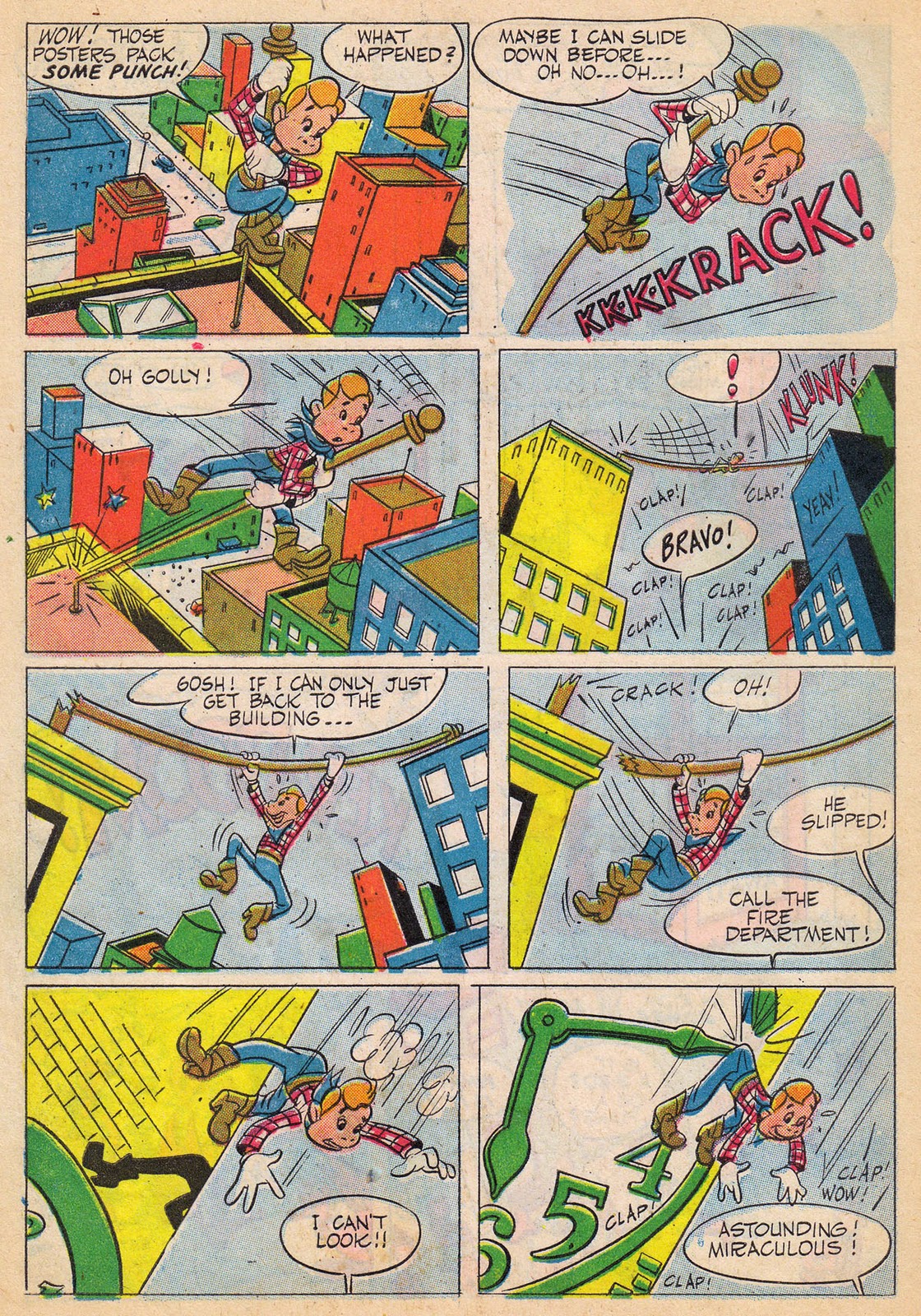
Howdy has a Tubby moment on p.2, when he squanders an entire day watching a steam-shovel in action. His reaction to the end of the operator's workday, in panel seven of that page, is quite amusing. The Tubby-Type compulsion to fixate has made an entire day pass in a blur.

In best Tubby-Type fashion, Howdy panics in the last panel, and on the top half of p.3, before a series of escalating events helps him belatedly achieve his goal.

Sheer chaos garners much better results for Howdy--he becomes a figure of public adulation and he's rewarded by his superior, Mister Bluster. Had Howdy not zoned out on the steam-shovel action, and spent his day papering the city, the endgame might not have been so profitable!

Stanley's love of crowd scenes shows its hand on pps. 3 and 6. The arrangement and body language of the long-shots at the bottom of p. 3 are typical of Stanley's 1940s and '50s work.

For "Howdy and the Pirates," the debut issue's longest story, Stanley returned to the knockabout comedy-adventure of his longer Andy Panda and Oswald Rabbit stories of the mid-1940s. This story also prefaces the first "Tubby" solo story, "Captain Yo-Yo," minus much of the 1952 story's playfulness and wit.


Stanley's villains typically take up more space than his protagonists. This story's modern day pirates are large, picaresque figures who pose a genuine threat to our trio of de facto heroes.

After several pages of spirited, knockabout farce, peppered with "YOW"s and "Ha! Ha! Ha!"s, this story peters out on its last page. The Scooby-Doo ending is a real cop-out. Perhaps Stanley wrote himself out, and just wanted to wrap it up and get it done.

The most peculiar member of the Howdy Doody troupe was the whatizzit critter Flub-a-Dub. Thanks to the photo-filled covers and inner covers of early Doody issues, I can show you what the real puppet looked like. Here, you can also see Bob Smith and another Doody character who figures in the following story, Clarabell the mute clown:

Though he had yet to get a grasp on the admittedly limited possibilities of the Doody troupe, Stanley immediately seized on Flub-a-Dub's gadfly/outsider persona. This is the classic John Stanley anti-hero, and right away he's drawn to the bizarre beast-thing's possibilities for comedic chaos and stakes-raising.


The cop on p.2 looks much like Stanley's drawing style of the 1950s, as do some of the other incidental human figures. Otherwise, this is a pretty basic, uninspired story that's distinguished by its energy and Flub-a-Dub's a-hole actions.

Stanley soon shared the Doody duties with other writers. He contributed a substantial amount of work to the series, which lasted 38 issues, plus some one-shot follow-ups.


At the risk of overkill, here's a story from the fifth Doody issue. It stars Howdy's nebbish-sidekick, Dilly Dally, in the sort of waking nightmare that distinguishes some of Stanley's better 1950s stories:


Again, this is not masterpiece stuff. The accelerating repercussions of poor Dilly's attempt to loaf and nap, culminating in the vivid freakout of p. 7, show Stanley's hand quite strongly.

Chances are, Stanley wasn't particularly invested in the work, as he seemed to be with Little Lulu and Tubby. Nonetheless, his telltale themes and images run through these stories. Thus, they still stand out after 60 years--long after the original Howdy Doody and Co. have largely perished from the national consciousness.

Sunday, July 18, 2010

Another Stanley Discovery: Stories From Various "Rootie Kazootie" Comics, 1952-4

Yes, friends, I've uncovered more obscure John Stanley material. I thought "Howdy Doody" was an unlikely source of Stanley comics! Well, here's another early TV Dell spin-off that is clearly our man's handiwork.

"Rootie Kazootie" was, like "Howdy Doody," a early live-action puppet show success. It ran from 1950 to '54. Although phrases from the show, such as "gosharootie," still linger in our lexicon, the program itself is just a vague memory to aging Baby Boomers. (YouTube should have excerpts, if you're really that interested.)

Rootie was popular enough to have a slew of Western Publishing-created merchandise. He also starred in the first issue of Dell's sole 3-D title, imaginatively named 3-D-ell. (FOLLOW-UP: I've just seen this book. It contains no Stanley material. It's made of Viewmaster-style photos of the show's puppets, with crude cut-out SFX. Another one for the recycle bin, alas...)

File these factoids under "Information, Useless." Stanley's involvement with the six Kazootie comics Dell published was apparently shared with other writer/artist creative teams. Stanley's efforts, loaded with tells, have artwork by Dan Gormley (which is, itself, a tell). Three of the six issues were "Four-Color" tryouts.

When "Kazootie"-mania ebbed with the show's cancellation in 1954, so did the Dell funny-books.

Like the Howdy Doody comics, these are not major works. The fact that they exist is a surprise to me. Only this morning did I succumb to curiosity and download the four available scanned issues of Kazootie. I've been down this road many times in the course of my research; obscure Dell title looks promising; download-download-download; peruse; realize contents are lifeless twaddle; move to Recycle Bin; click EMPTY.

This time, it paid off. I repeat--this is not first-rate John Stanley material. There are several thematic ties with Stanley's contemporary work on Little Lulu. Plus, there are these stylistic tells:

  • wild physical action
  • crowd scenes
  • SFX in speech balloons
  • ...ellipses...
  • "Ha! Ha! Ha!" (and, in our first story, the seldom-seen variant 'Henh! Henh!')

And, most importantly, these are narratives that (a) have stakes; (b) are amusing, with literate dialogue; and (c) actually go somewhere, in a satisfying manner.


Rootie is as bland as (if not blander than) Howdy Doody. Stanley does what he can with the material, but the only characters he can really sink his teeth into are the villains, which display many vivid traits of Stanley's Terrible Thwarter/Obstacle archetype.

Here's an untitled story from the third Kazootie comic, "Four-Color" #502, published in 1953.

As with the Howdy Doody comics, a TV puppet is brought to comic-book life--no strings attached. Rootie's "Magic Kazootie," the character's chief gimmick, is nowhere in sight here.

The clubhouse thing is a no-brainer tie-in with the Lulu family comics. The narrative twist of the secret tunnel that leads to the an abandoned mansion is a stronger dose of Stanley's imagination. This type of subconscious, near-nightmare imagery hooks up with such Stanley stories as "The Guest In The Ghost Hotel" (Tubby #7). It also connects with the dozens of "Lulu" and "Tubby" pieces that include abandoned houses, which are usually considered haunted by the kids who prowl through them.

Another Stanley tell occurs on page 8, when the grandfather clock bongs 11 times in a row--with each bong given an exclamation mark. As a writer who loved crowd scenes, Stanley applied the same dynamic to his sound effects. He filled his panels, when needed, with aggressive SFX. Whether they are the jagged-lettered BLANGs, BAMs and KLUNKs that pepper his panels, or the en masse outbursts of people or appliances, Stanley's SFX are in the reader's face, inviting them to feel the noise and accept the frenzy.

Here's another "Rootie" story rooted in the principles of Little Lulu--from the first Four-Color book, #415, from 1952:
The war of the pre-pubescent sexes, cross-dressing, smart girls out-witting smug, cocky boys and frenzied physical comedy distinguish this also-untitled story. The ever-present ellipses and the cruel chorus of "Ha, Ha, Ha, Ha, Ha, Ha!" at story's end also tip the author's hand here.

In another story from these three "Four Color" trial issues, there's a simulacrum of Lulu's feared West Side Boys--the alpha-kid a-holes who exist to create trouble for Tubby and his clubhouse pals. Here's a sample page that shows the rival "Tough Guys Club," with Polka Dottie doing a "Lulu":


Stanley obviously did not reinvent the wheel here. He took formulas that worked for Little Lulu and recycled them to fit this somewhat similar licensed property.

In today's final selection, from the second "Kazootie" (Four-Color #459), Rootie is a real asshole. He's endowed with the Tubby-Type characteristics, to which Polka-Dottie plays the traditional Little Lulu role.

The cramped urban environment of this story is right out of Stanley's Lulu as well.


Fences are a common sight in Stanley's 1950s stories. They exist to keep things away from both protagonists and antagonists, as a means of shelter or transformation, and as a dramatic stakes-raiser. This story offers an intriguing combination of the boys-vs-girls business and the use of a fence as a narrative booster.

Rootie is put through the paces for his Tubby-esque behavior by Polka Dottie, who turns the tables on him, status-wise. Yes, it's Lulu-Lite, but the thematic ties to Stanley's more significant '50s work cannot be denied.

By the end of the 1940s, Stanley's page layouts were typically four tiers, with two panels per tier. The rhythm of his best Little Lulu work belongs to this less open, more snappy presentation.

As noted earlier, the Kazootie comics were clearly sub-divided to a few creative teams. The other creators used unusually airy, open three-tier pages. One of these teams elected to emulate Stanley's fairy-tale format from Little Lulu. In each issue, Rootie tells a story to his dog, Gala-Poochie.

Stanley's eloquent fairy-tales are both remarkable narratives and witty extrapolations on the tropes of story-telling. These faux-fables are heavily moralistic, and take great pains to underline said moral at the conclusion. They are not first-person stories. There is no tongue in cheek; the protagonist is forced to conform to the narrative's moral. There is no playful discrepancy between the narrator's version of the events and what is shown in the panel itself.

It is fascinating to see another comics creator attempt to write like John Stanley--without getting what made Stanley's work so compelling and distinct.

The most solid stories in these comics function as a shadow of the Little Lulu universe. Stanley and the other writers play with the "Magic Kazootie" gimmick, but those stories are typically less fulfilling than the non-fantasy elements of the three stories I've presented here.

Who knows what will turn up next? It's clear that the 1950s were not entirely about "Little Lulu" and "Tubby" for John Stanley.