Showing posts with label Is This Stanley's Work?. Show all posts

Friday, July 21, 2017

Post-Mortem Post 009: The Sweetie Pie Conundrum

As I've studied the output of Western Publications, and tried to determine which of their published comic book stories are the work of John Stanley, I've had my doubts about several pieces. Most of them I've included, with my reservations noted, in the three-book, decade-specific bibliographies I have self-published, and which are available on amazon.com.

The gag cartoonist and animation creator Sam Henderson brought to my attention two issues from Dell Comics' one-shot series, known to collectors and historians as "Four Color Comics." The books were based, as were almost all the Four Colors, on a popular culture property. 

Nadine Seltzer's newspaper comic panel Sweetie Pie was one of several imitations of Hank Ketcham's popular Dennis the Menace, which debuted in 1951. Seltzer's feature was syndicated by Newspaper Enterprise Association, which offered its clients--mostly urban evening dailies and small-town papers--a package of comics, columns and features, which they were free to use as needed. The panel ran from 1954 to 1967, but is rarely found in client newspapers which seemed to use most, or all, of the NEA allotment.

Drawn with an attempt to achieve the elided elegance of Ketcham's cartooning, Sweetie Pie suffered from the main flaw of its inspiration source: a grating main character and a general mood of anger and violence. None of these brat-kid strips from the 1950s have aged well. Seltzer's derivative strip was popular enough in its day to be twice collected in paperback books, and twice in original comic book series.

The Ajax-Farrell imprint, best known for its nightmarish, bizarre horror titles, edited by the enigmatic Ruth Roche, released two all-original Sweetie Pie comic books in 1955 and '56. They were clearly based on the Dennis the Menace comic books published by Standard/Pines, which began in 1953. 

The two paperback collections were published in 1955 and 1957, concurrent with the Ajax-Farrell comic books. Four-ish years later, with the panel cartoon among the lower ranks of syndicated comics, Dell's pair of Sweetie Pies saw print. The first issue, #1185, has a publication date of May-July 1961. The follow-up, #1241, has a November 1961/January 1962 date. 

These two books coincide with John Stanley's last few Nancy and Sluggo comics for Dell. Like those comics, the Sweetie Pies were drawn by Dan Gormley, in a style not far from his take on Ernie Bushmiller's Nancy. The stories feel like John Stanley's work, with elements of his Nancy and later Little Lulu stories. Yet there's something off about them. If they're Stanley's work, they are diluted, sedated stuff. They're quieter than Stanley's work of the period, which was given to much flailing of arms, shouting and dashing about.

Stanley's comics got louder from 1956 on, with characters using their outdoor voices at top volume. From Marge's Little Lulu #101, 1956:
And, more appropriate to this post, a sample page from the first issue of Around the Block with Dunc 'n Loo, which saw print around the time of the first Sweetie Pie:
There is some variance in volume in the following stories--and other touches familiar to Stanley's 1950s and early '60s work. Here is a selection of stories from the two Dell Sweetie Pie comics. See what you think:
"Clothes Make the Dummy" uses a story gimmick John Stanley made hay with in two stories--a long narrative from Henry Aldrich #4 and a short piece from Marge's Little Lulu #11, 1949.
Its mistaken-identity angle--with the disguised dressmaker's dummy confused with "Shiek Aboo from Abool-Bool"--is in line with the sitcom frolics of Dunc 'n' Loo or Kookie, two original Stanley series from this period.

Sweetie Pie and Lester are almost interchangable with Nancy and Sluggo, or a blander version of Little Lulu and Tubby. Sweetie Pie is something like the earliest Stanley version of Lulu--a mischief-maker and know-it-all. As those qualities rubbed off on the Tubby character, by 1949, Stanley made Lulu a fully recognizable and more complex being.

Like some of Stanley's lesser 1950s jobs, the story feels more-or-less like the man's work, but lacks the fire and wit that informs his best material.

Two stories from the second Sweetie Pie continue this vibe.

"Pitcher's Plight" could be the work of the late Jack Mendelsohn, whose wit and fondness for wordplay complements John Stanley's. That's just a wild guess. Its theme of a character fixated on one trait or profession, to the befuddlement (and endangerment) of others, is a plot device Stanley used many times in his career. The story is amusing, but something doesn't gel.

"The Eyes Have It" is more in line with Stanley's work of this period in its use of a brassy, oversized adversary-- the Terrible Thwarter/Obstacle persona that I discuss in this 2009 essay. In both stories, the character of Sweetie Pie sits between Stanley's Lulu and Nancy. She is more a mischief-maker than post-1948 Lulu and has the blunt unlikability of his Nancy. She's an improvement on Seltzer's one-note mayhem tot. If this isn't Stanley's work, it's someone who followed his lead, and took a licensed property, threw out 95% of the character's shtick and reimagined the entity and its world.

Panels such as these two, taken from other stories, would cause a casual reader to think "John Stanley:"
These two books could be the work of another writer doing their best impression of John Stanley, or Stanley at a lower ebb, trying to make a living in a business that would soon chew him up and spit him out. In either case, the pair of Sweetie Pies are a small conundrum stuck in an obscure corner of comic book history.

Tuesday, August 10, 2010

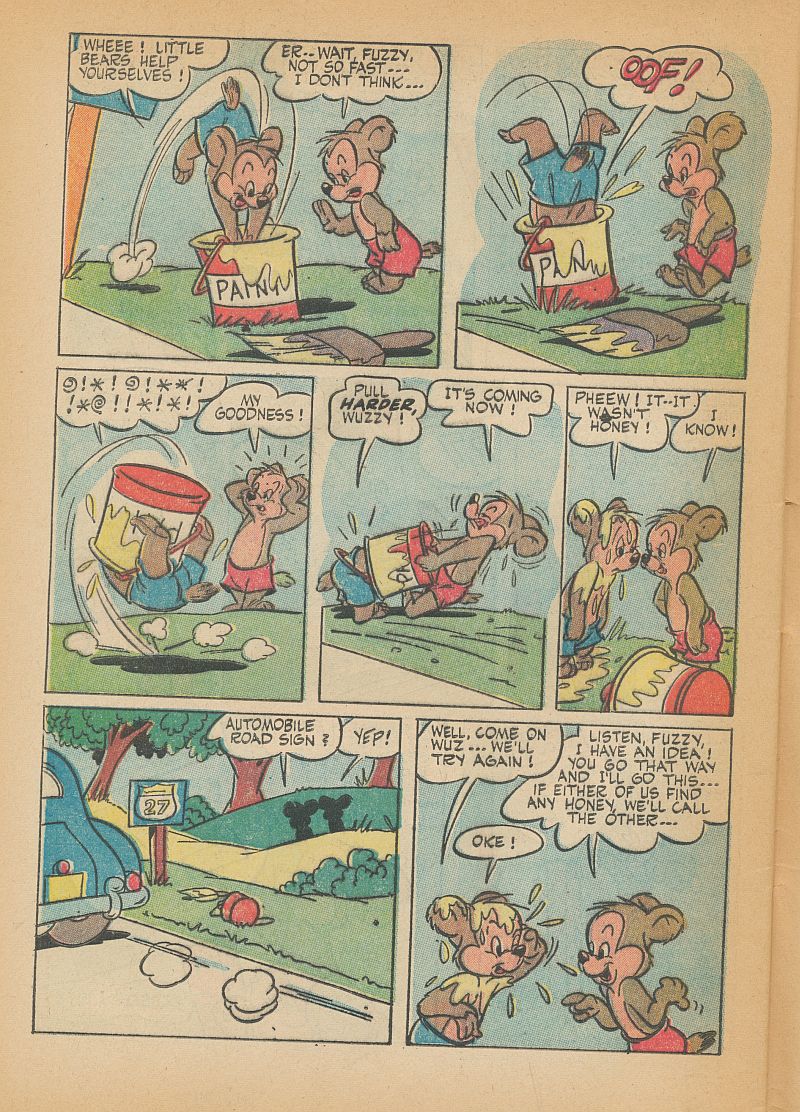
Is This Stanley's Work? "Fuzzy and Wuzzy," from Our Gang Comics #58, May 1949

Mark Kausler and Ed Buchman sent me these scans. They wondered if this could be a John Stanley story. As I'm still searching for "unknown" pieces from the late 1940s and early 1950s, I'm grateful to have possible items brought to my attention. Thanks once again, Mark, for sharing rare material--and going to the trouble of scanning it!

This story is very close in feel to the Krazy Kat, Howdy Doody and Rootie Kazootie material I've posted here. Like those stories, it is lesser work. It lacks the core investment of Stanley's Little Lulu and Tubby material.

That said, the characterizations are strong and distinct, their interactions are amusing, and the simple story does not meander, but moves in confident strides.

It's drawn by Dan Gormley, and gorgeous funny-animal cartoon art it is. One odd thing about this story is that it's set up in three-tier pages. Stanley preferred four-tier pages, and after 1947, we seldom, if ever, see him stray from that format.

"Fuzzy and Wuzzy" were comic book creations affixed to a minor MGM cartoon property, Barney Bear. They never appeared in any of the lumbering fella's fair-to-middling MGM cartoons. They were, I think, attempts to make the Huey, Dewey and Louie angle strike twice. The attachment of nutty "nephews" to an adult licensed property was typical of this era.

Carl Barks made this formula work by making Donald's three nephews smarter, more resourceful and more logical than their older parental figure. Western/Dell imitations such as this and Woody Woodpecker's "Knothead and Splinter" served only to relieve the star characters of needing a strong personality. Barney, Woody and other licensed entities became armchair-sitting, newspaper-reading suburban Blahmen, either befuddled or patronizingly amused by their young charges' wacky-nutty antics.

Enough yak yak from me. Here's the story...


Not the greatest comic book story ever made... but one with several significant Stanley 'tells' (or, as one reader has suggested they be called, 'earmuffs'):

  • frantic physical action (throughout)
  • slightly delusional behavior
  • strong visual spotting of sound effects
  • one YOW!
  • one instance of Ha! Ha! Ha! (8x)
  • one instance of spots-before-eyes
  • one instance of windmill action

If this is Stanley's work, it's a stylistic throwback to his New Funnies material of the mid-1940s. It's apt that Dan Gormley illustrated this piece--that furthers the similarity. It also harkens back to an earlier Stanley stint on Our Gang. His "Tom and Jerry" stories focused more on the two mice, Jerry and Tuffy, and their ongoing bewilderment with the world of human beings.

Fuzzy and Wuzzy are much like Jerry and Tuffy. One is a bit of a loose cannon, fearless to explore the unknown. The other is more uptight, cautionary and reserved. Both are naive and unaccustomed to their surroundings--from whence springeth the comedy.

The stakes are lower than usual here. There is no authority figure to answer to--just the call to adventure and the solution of hunger.

Theory Dept.: there is the possibility that this is the work of another person, who was either heavily influenced by John Stanley's writing, or asked to emulate the overall style, since it was popular and it sold comic books. I still have this suspicion, entirely unfounded, in the back of my mind.

Comic books were a business, first and foremost, and an art-form only to a handful of divinely deluded souls in the 1940s. Like movies, automobiles and appliances, comic books were meant to sell and make money. Therefore, a winning recipe or formula was rife for imitation.

The Western Publications history is largely unknown. Most, if not all of those who were involved in its heyday are long gone. I stress that this is just supposition on my part.

Another likelihood is that Stanley needed money, and that he dashed these lesser stories off to supplement his income from Little Lulu. They were very likely forgotten as quickly as they were written. No one thought some middle-aged nutjob would pore over them 50-60 years later. They're not bad stories... they just don't have much invested in them. Stanley saved his best ideas--and writing--for the Lulu titles.

At best, these minor stories of the 1950s are amusing and coherent--which cannot be said about most of Western's output.

I'd love to know what you think about this and the other stories in the "Is This Stanley's Work?" series.

Wednesday, February 10, 2010

Is This Stanley's Work? "Homer Brown," from Henry Aldrich 2, 1950

I haven't done one of these "Is This Stanley's Work" posts in awhile. For the sheer sweet sake of variety, here's a return to that occasional berth on Stanley Stories.
A potential problem with focusing on one subject so intently, as I do here, is that, after awhile, it becomes inevitable that I'm going to repeat myself--in story choices, commentary, et al. I strive to keep this blog fresh for you, the reader, and for me, the writer.
As well, as I continue to explore the back-waters of the Dell Comics output from 1942 to 1962--prime years for John Stanley, who remained alarmingly prolific for these two decades--I find a certain amount of pieces I'm not 100% sure about.
This story is in that category. It has some tell-tale Stanley-ian touches, both in characterization and technique. It feels like it could be a Thirteen Going on Eighteen story in many ways.
And, because of Bill Williams' elegant cartooning, there are obvious ties to Stanley's Dunc 'n' Loo.
Still... I dunno...read this story and tell me what you think.
The puzzler is that, according to "official" comics history, John Stanley only wrote some of the first issue of the Henry Aldrich comic book. The very best story from that first issue (and, quite honestly, the only one I feel is truly Stanley's work) was posted here awhile back. It is burned into my memory, as it was the last story I posted on my dearly departed, much missed Mac Mini, which kicked the bucket mere hours after that post, which you can see HERE.
I remain optimistic that this piece, from the second issue of Aldrich, may be Stanley's work. The stories in this series vary greatly in narrative quality, even within a single issue. This suggests, to me, that a number of writers worked on this series.

Anyway, here 'tis. See you afterwards...

The Loo-like qualities of Homer Brown, nebbishly, unconfident sidekick to all-American boy Henry Aldrich, the coarse, aggressive, single-minded vision of the girl's father, the girl, herself, who is accusatory and threatening, yet understanding and assured, the WAZZ and WHIZZ SFX of Homer's jalopy, and the non-sequitur final line of dialogue that manages to fabulously conclude the story...

These elements all suggest John Stanley to me. And, as Bill Williams was a strong enough visual stylist to enforce his own layout concepts on Stanley's writing, the story's slightly offbeat feel mirrors the later Stanley/Williams collaboration on Dunc 'n' Loo and Kookie.

Stanley hadn't yet gotten into the staccato style of writing that would be common in the later 1950s. His Little Lulu stories of 1950 share a similar laid-back vibe to this story.

Well, durnit, I've just about convinced myself that this is John Stanley's work. All the same, I welcome your feedback. What do you think?

Wednesday, September 23, 2009

Is This Stanley's Work? "Frosty the Snowman," Four-Color 359, 1951

JOYVILLE, a great blog by the very talented Gabriel Corbera, has just posted what appears to be a "Frosty the Snowman" story that appears to be by John Stanley.

What do you think? It has many Stanley-ian "tells." It could have been written by Frank Thomas, a journeyman cartoonist/writer who seemingly modeled himself after Stanley's example in the 1940s.

The general darkness of the story points it in Stanley's direction. As ever, I welcome your input. Some of these "Is This Stanley's Work" pieces are really tough calls.

Be sure to peruse Gabriel's delightful site... there are hours of great links and postings in Joyville!

PS; Apologies for the formerly confusing headline... those are the risks of the auto-complete function in Blogger!

Thursday, September 3, 2009

Is This Stanley's Work? The Last of "Li'l Eight-Ball," New Funnies 126, 1947; Edenic Subway Trek Proves Living Nightmare

I've written about the controversial Li'l Eight-Ball on the defunct prior incarnations of this blog/site. His presence in the New Funnies anthology, home of many Stanley stories from 1943 to '48, has caused many PC Police alarms to be set off in recent years.

The 1940s witnessed a resurrection of Afro-American stereotypes in American pop-culture. They'd not exactly disappeared, but they assumed a higher, brassier profile, especially during the war years.

This may have been a side-effect of the highly visible Afro-American presence among US troops during World War II. I'm certain books have been written on this issue, and I don't pretend to be a social anthropologist.

Still, one wonders why there was such a strong resurgence in offensive anti-AA imagery in the 1940s. It continued after the war (in fact, it reached a horrifying peak in Tex Avery's 1948 MGM cartoon, Half-Pint Pygmy, a structurally brilliant effort horribly marred by its mis-use of a black character.)

Li'l Eight-Ball was a creation of the late 1930s. He first appeared in the Walter Lantz Cartune A-Haunting We Will Go, directed by ex-Disney nutjob Burt Gillett and feautring uncredited vocals by Mel Blanc.

This cartoon can be seen on Universal's second Woody Woodpecker and Friends DVD collection. Stereotypes aside, it's a charming, rather wild-spirited cartoon.

Eight-Ball fizzled out, as did Oswald Rabbit and Homer Pigeon, as a bona-fide screen star. As comic-book properties, all three had a long-lived berth in New Funnies.

The story presented today, which may or may not be Stanley's work, was Li'l Eight-Ball's final comic book appearance.

Stanley sporadically wrote the "Eight-Ball" feature. His most memorable entry, which I plan to re-scan and re-post here soon, was in NF 101--a nightmarish, Roald Dahl-esque fantasia filled with traumatic images and events.

This final story has ample creativity, nightmare imagery, and fourth-wall breaking to suggest John Stanley wrote it. Something in its overall flow doesn't feel right to me. Thus, I ask, in all sincerity: whadda you think? Stanley? Not Stanley?


Eight-Ball's hush-mah-mouf dialect is absent from this story, which has the intense urban atmosphere typical of Stanley's work. Most of Eight-Ball's comix stories take place in a pokey rural environment.

The story is a pointed satire of mass transit--an almost Kurtzman-esque series of expectation-reversals. This story might have been the daydream of many a post-war New York commuter--kind treatment by transit staff, comfortable seating, coddling and endless freebies. That is, until events take a turn for the worse.

Before darkness falls, amidst the humorous switcheroos on the commuter experience, one gentle self-referential moment pointedly reminds us we're reading a funny-book: in fact, the very issue that the addled news-dealer offers to Eight-Ball:


Here's the cover of this issue:


This business seems too clever for a staff writer, or another free-lancer. It smacks of an "inside job"--akin to the Woody Woodpecker story posted HERE, from the previous issue of New Funnies, which has caricatures of Oskar Lebeck's staff, including John Stanley.

Eight-Ball's exit from the Comfy Transit System, and his engulfment in the dark bowels of the RIP (Rapid Inter-Urban Perambulation?), offers a striking prediction of the techniques of EC artist Bernard Krigstein. As well, this sequence contains Stanley's trademark "floating eyes in blackness" and sinister "Heh! Heh! Heh!" motif:


Enough Stanley tics appear in this story to convince me it's his work. As we've seen with other stories, his work varies in quality and impact, possibly due to editorial input. This may be another instance of Stanley's work being revised by another hand.

If this isn't Stanley, it's a decent imitation. Stories such as this one remain puzzles to me. As said, I'm almost convinced--at least 88.8% certain this is John Stanley's work.

As poor Eight-Ball's adieu to the printed page--possibly his final appearance in American mass media 'til the DVD revival in 2007--this story is a remarkable end to an unremarkable career.

PS: For a fascinating complement to this post, please visit Michael Barrier's blog for T H I S follow-up piece. It answers some of the questions I ponder here, and offers Mr. Barrier's smart and savvy thoughts on the matter.