Friday, January 7, 2011

Deep Doody: More of John Stanley's Howdy Doody comics, 1949/50

Happy '11 to you all. For our first 2011 post, here are some more stories from Dell's Howdy Doody comic book. I've finally acquired the missing issues in the book's long run. Early and late issues are full of John Stanley material.

At the time, Howdy was as big a pop culture property--bigger, possibly--than Marge Buell's "Little Lulu." He was arguably the first big celebrity of the TV age. Dell's comic book was the format's first TV adaptation. Turning TV into funnybooks continues to be profitable, well into this 21st century of ours.

By this time, Stanley had developed a more controlled, sophisticated approach to comics with the Lulu series. Those stories are the most disciplined, reined-in work of his career. He did very well by the disciplines of Lulu, and created character-rich, clear and satisfying narratives.

Stanley's antic side had not died away. In his side projects of the 1950s, he kept his wilder tendencies in good shape. The broader, louder, more violent material that was mostly out of place in Little Lulu runs rampant in his other '50s work.

At the close of the 1950s, Stanley joined this brassier part of his creative persona with the more upscale tendencies of Lulu and set the stage for his most assured, risk-taking work of the 1960s.

As usual for a new Stanley project, this first issue of Doody is uncertain but spirited. Stanley may have worked closely with Bob Smith, the host/owner of the "Doody" franchise, on this premiere book.

Stanley's unfamiliarity with the characters hinders his work.  He uses tried-and-true story formulas to find his way into the "Doody" universe, with mixed results.

The book's opening story is a prime example of seat-of-the-pants storytelling. Stanley tended to improvise his stories, with no sense of where they would end up. This story is a cheerful example of his ODTAA (One Damned Thing After Another) story style.


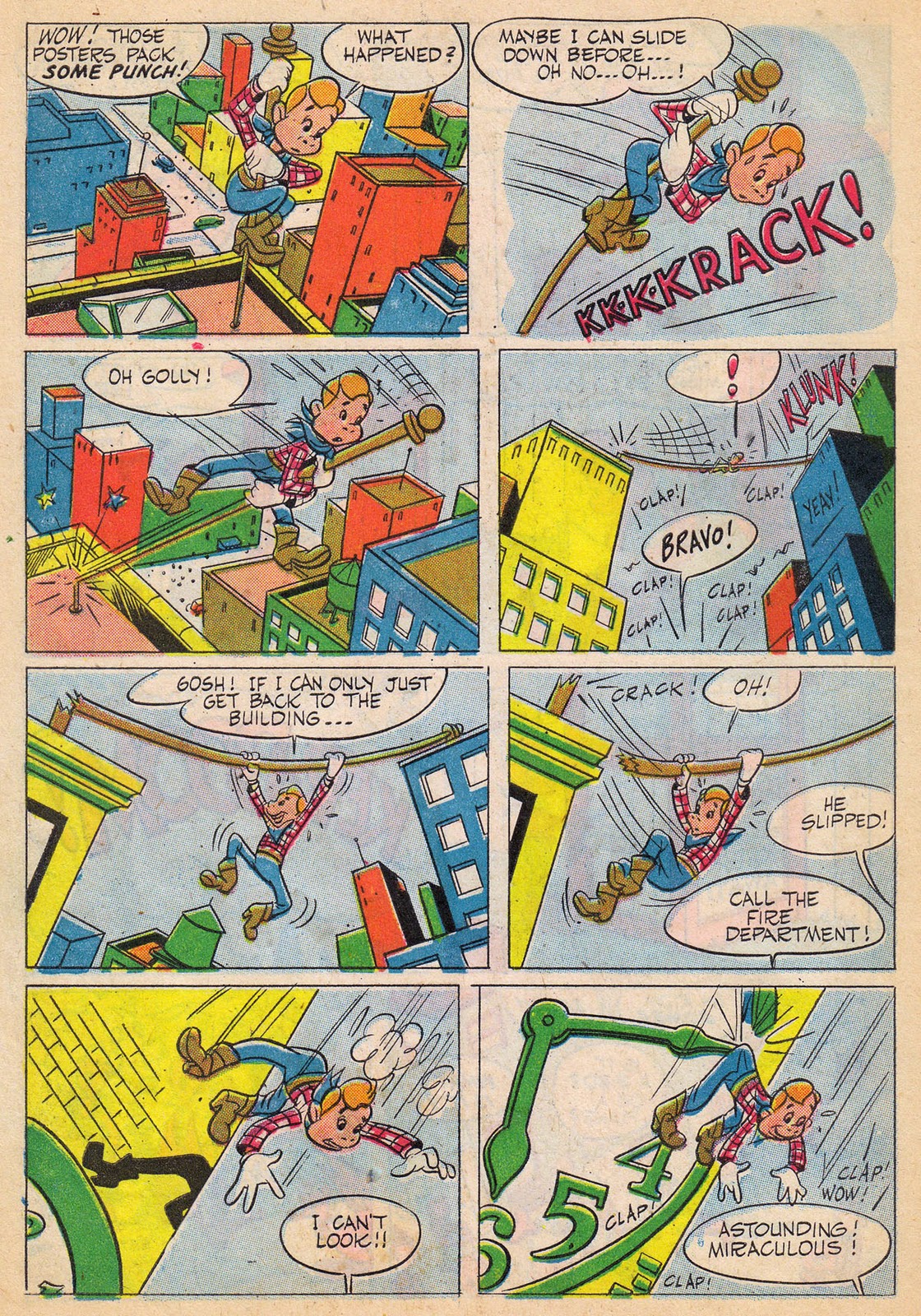
Howdy has a Tubby moment on p.2, when he squanders an entire day watching a steam-shovel in action. His reaction to the end of the operator's workday, in panel seven of that page, is quite amusing. The Tubby-Type compulsion to fixate has made an entire day pass in a blur.

In best Tubby-Type fashion, Howdy panics in the last panel, and on the top half of p.3, before a series of escalating events helps him belatedly achieve his goal.

Sheer chaos garners much better results for Howdy--he becomes a figure of public adulation and he's rewarded by his superior, Mister Bluster. Had Howdy not zoned out on the steam-shovel action, and spent his day papering the city, the endgame might not have been so profitable!

Stanley's love of crowd scenes shows its hand on pps. 3 and 6. The arrangement and body language of the long-shots at the bottom of p. 3 are typical of Stanley's 1940s and '50s work.

For "Howdy and the Pirates," the debut issue's longest story, Stanley returned to the knockabout comedy-adventure of his longer Andy Panda and Oswald Rabbit stories of the mid-1940s. This story also prefaces the first "Tubby" solo story, "Captain Yo-Yo," minus much of the 1952 story's playfulness and wit.


Stanley's villains typically take up more space than his protagonists. This story's modern day pirates are large, picaresque figures who pose a genuine threat to our trio of de facto heroes.

After several pages of spirited, knockabout farce, peppered with "YOW"s and "Ha! Ha! Ha!"s, this story peters out on its last page. The Scooby-Doo ending is a real cop-out. Perhaps Stanley wrote himself out, and just wanted to wrap it up and get it done.

The most peculiar member of the Howdy Doody troupe was the whatizzit critter Flub-a-Dub. Thanks to the photo-filled covers and inner covers of early Doody issues, I can show you what the real puppet looked like. Here, you can also see Bob Smith and another Doody character who figures in the following story, Clarabell the mute clown:

Though he had yet to get a grasp on the admittedly limited possibilities of the Doody troupe, Stanley immediately seized on Flub-a-Dub's gadfly/outsider persona. This is the classic John Stanley anti-hero, and right away he's drawn to the bizarre beast-thing's possibilities for comedic chaos and stakes-raising.


The cop on p.2 looks much like Stanley's drawing style of the 1950s, as do some of the other incidental human figures. Otherwise, this is a pretty basic, uninspired story that's distinguished by its energy and Flub-a-Dub's a-hole actions.

Stanley soon shared the Doody duties with other writers. He contributed a substantial amount of work to the series, which lasted 38 issues, plus some one-shot follow-ups.


At the risk of overkill, here's a story from the fifth Doody issue. It stars Howdy's nebbish-sidekick, Dilly Dally, in the sort of waking nightmare that distinguishes some of Stanley's better 1950s stories:


Again, this is not masterpiece stuff. The accelerating repercussions of poor Dilly's attempt to loaf and nap, culminating in the vivid freakout of p. 7, show Stanley's hand quite strongly.

Chances are, Stanley wasn't particularly invested in the work, as he seemed to be with Little Lulu and Tubby. Nonetheless, his telltale themes and images run through these stories. Thus, they still stand out after 60 years--long after the original Howdy Doody and Co. have largely perished from the national consciousness.

Friday, December 31, 2010

The Last Post of 2010: Potty Humor and Animal Conflict...two very early "Tom and Jerry" stories (Our Gang Comics 6 and 7, 1943)

Here are the last two really early Stanley stories I have on hand. I could swear I've already posted today's first story. It's memorable, and you'll soon notice why. An exhaustive search of the Stanley Stories site showed no evidence of it anywhere. I fully acknowledge that I may have missed it. If so, please excuse my oblivious state of mind.

This first story, from Our Gang Comics #6, brims with Stanley's distinct energy, comedy and sound effects. It also features what may be the comics' first unabridged view of the American bathroom--complete with a visible toilet which prominently features in the action.

The commode was a big no-no in mainstream media. Animated cartoons made before the Production Code show us glimpses of it, as do feature films such as King Vidor's The Crowd (1928). The loo was something that existed, and was a part of every American's daily life. It simply wasn't shown in our mass entertainments. Not too often, anyway...


Did you notice the box of "Kelly's Liver Pills" in the first panel of p.3? Western's comics creators were unanimously fond of dropping one another's names in their stories. Kelly, Carl Barks, Dan Noonan and Stanley are the most frequently referenced.

Much of the charm of Stanley's "Tom and Jerry" stories occurs when the mice Jerry and Tuffy explore the mystifying world of mankind. Their cat-like curiosity brings them to the bathroom, where they encounter a sentient electric razor (an image reminiscent of Chuck Jones' 1939 cartoon Naughty But Mice), the tub, sink, various perfumes, powders and potions and, finally, the verboten commode.

Toilets were the thing people didn't talk about in popular culture. To this day, movies, TV and popular fiction assiduously avoid showing this common everyday item. Think of it: when was the last time the hero of a TV show stopped to relieve himself in a restroom? 

Alfred Hitchcock's Psycho shocked 1960s audiences with its dead-on, confrontational views of a hotel commode (a device that figures prominently in one of the movie's plot points, as it does in this T&J story). The sight of a commode in post-Production Code movies are tangential and fleeting.

Perhaps out of naivete, Stanley gives us fearless toilet comedy in this story. The commode's lid is conveniently removed--the better for the mice to frolic around its innards.

This is one of the funniest and broadest of Stanley's early works. Even tho' the shock value of the potty has long worn off, the bathroom antics of the mice are genuinely ticklish. Stanley SFX trainspotters will relish the unique occurrence of "UFFLE!" on p. 4.

As I've noted elsewhere, there is a strong tie between Stanley's earliest comics work (1943-46) and his most realized, mature material of the 1960s. A major agent in Stanley's mature work is the fearless incorporation of broad, knockabout physical humor. Stanley got away from physical comedy in the most high-profile portion of his career, the Lulu Years (1947-1959).

There is a great deal of physical comedy in Little Lulu, but it's much tighter and more reined-in than the wild, limb-thrashing business we see here, and, later, in Dunc 'n Loo and Thirteen Going On Eighteen.

Those who eschew Stanley's early works might rankle at this statement, but it's true. This very brassy physical farce-comedy is the meat and potatoes of Stanley's late, mature work. The main difference is the issue of narrative stakes.

The 1960s Stanley was a seasoned comics writer who understood the intricacies of status, action and reaction and the plot-point pyramid. He used these tools as their master.

In 1943, the stakes are much lower. In a life and death scenario, none of the characters take their roles really seriously. Jerry and Tuffy don't really fear being caught and eaten by Tom. Tom is an a-hole aggressor who gets his kicks toying with the mice, while striving, in vain, to retain a higher status in the household. The stereotyped Mammy maid holds the upper hand. Hers is the power to shoo them all away or tolerate/ignore them.

Stanley's comedy--and its vivid energy--carry his early stories. From the start, he was a very witty writer--more so than Barks, and certainly Kelly's equal, if not occasionally his superior.

Stanley's next T&J story continues in this vibrant, humorous bent. This story contains one of the first occurrences of a Stanleyism: spots-before-the-eyes. These occur time and again in his later work, to connote dizziness, confusion, stunned silence or sickness.

Both these stories include some of Stanley's earliest YOWs.


Rare references to current events occur in this story. In the last panel of p.3, Tom quips, "I don't need any ration coupons to eat you guys!" Jerry's smart-crack in the succeeding panel is lost to 2010 (or 2011) readers. Even I, seasoned viewer of wartime Warner Brothers cartoons, didn't understand the significance of Jerry's retort.

You can read 1943 a letter at this blog that mentions the no. 17 rationing coupon, and tells that it was for the purchase of leather shoes.

In another, more fatalistic wartime reference, on p.4, the mice mistake a wooden toy soldier for an Allied front for their predator: "WE'RE SUNK! Tom's got the U. S. Marines on his side..." This offers a hint of the rodents' self-acknowledged status as societal outsiders. I'm sure that effect was not consciously intended by Stanley when he wrote this story.

The repetitive staging seen here is one of Stanley's most-used storytelling devices. As seen in the sequence of p.4, panels 5-6 and p.5, panels 1-2, the fixed viewpoint serves the comedy by heightening the futility of the tethered rodents' efforts.

Throughout the story, fixed viewpoints sustain comedy sequences. This is another strong tie to Stanley's mature work. Once again, the 1943 Stanley uses this device with some authority, but is clearly still learning the ropes of comics. The 1963 Stanley would use the fixed viewpoint to highlight his characters' failures, embarrassments, emotional shifts and status gains/losses.

It is fascinating to me to see that the young Stanley had access to the same tools that would so distinguish his late, most masterful work. Stanley grew into them, and made them an essential element of his storytelling, rather than expressive garnishes to rowdy, bright farces.

My Febreze-activated coughing and sneezing has increased during my work on this post. I'll celebrate the New Year with NyQuil. I hope you toast 2011's arrival with a more pleasant beverage, and that this new year brings us all more pleasing results than did '10.