There was some interest in seeing this early long John Stanley narrative. By no means is this among Stanley's better work. It is a decent example of his storytelling skills, largely devoid of his characteristic comedy.
A couple of tics emerge throughout this deadly-serious story. One is the eccentric 1940s beardo who appears early in the story. He gives the story a false comedic start that's immediately replaced by a Fredric Brown/Dorothy Hughes-esque mystery, garnished with Hitchcockian suspense set-pieces.
Well, take 15 minutes and read it yourself. Then we'll talk...
There is a fair deal of incidental comedy throughout "The Mad Dog Mystery." I dare say that the phrase "I'd walk a skunk for ten bucks!" is the funniest comment I've encountered so far today.
A mild theme of wartime intrigue gives the narrative some decent stakes. Stanley almost never included topical references in his work. Whereas Walt Kelly and Carl Barks played up the America-at-war angle for maximum drama and laffs in their contemporary stories, John Stanley disengaged from the realities of the day.
Kelly, in particular, played up the fifth-column angle like mad in his "Our Gang" stories, which "The Mad Dog Mystery" rather resembles with its rambly plot and childish protagonists. Barks, as in his "Terror of the River" and "Ghost of the Grotto," would have made the bad guys much more sinister in appearance.
The sequence in the houseboat is particularly Barksian. Left to die in the sinking, scuttled houseboat, Andy Panda and Charlie Chicken stoically prepare to meet their maker. Sheer practical survival-thinking--and a poor plastering job--save the day. The cramped 12-panel grid of the wartime Dell comics adds to the tension and sense of inescapable threat that pervades this sequence--and the whole story.
Stanley often gives a lumpen ordinariness to his antagonists. The traitorous scientist (and member of Stanley's antiques-loving Evil Rich) Klinker is a frumpy, seemingly ineffectual fellow. He's distinguishable from the cops who burst in as an un-needed deus ex machina at story's end. Klinker is slighter, more composed and less earthy than the derbied dicks.
The theme of the Evil Rich was a constant throughout Stanley's comics writing. Here is where he and Carl Barks part ways with a vengeance. Scrooge McDuck is a frequent violator of human rights--a driven individual who will stop at nothing to increase his already-absurd level of wealth. He has almost no time for anything but money.
Stanley's wealthy are idle aesthetes who fiddle with antiques, paintings and other trappings of the good life. Their actual money is almost never seen--in contrast to Scrooge McDuck's iconic Money Bin, and its owner's orgasmic rolls-in-the-hay with his cash. Money is the fetish-object of Scrooge McD's life. The trappings of wealth are the end-goal of Stanley's Evil Rich.
In Stanley's world, it is preferable for the elite to admire their Van Goof canvases, esoteric upholsteries of the 16th century, statuary, rare coins, books and whatnot. This keeps them distracted from the genuine harm and suffering their money and power can cause other people.
"The Mad Dog Mystery," a sorta-sequel to "The Secret Six," Stanley's Oswald Rabbit thriller of the same year, suffers from the vagueness of Klinker's actions. We never learn exactly what Klinker does--or how it helps "the enemy."
There is that canister of carefully-labeled lethal gas--the agent of Klinker's undoing, and a rare moment when Stanley's work aligns with the crude doings of the super-hero comics genre. Comics' mad scientists always seem to have such a clearly-marked supply of dangerous acid, gas or poison on hand. I'm pretty sure it was in their contracts to do so.
Stanley was usually alert about genre cliches and how to bend them. Such occurrences are usually tongue-in-cheek in his work.
Of course, this is from the early period of Stanley's career as a comics writer. He was still learning, and still forming the vision that became so distinct by the later 1940s. The relentless flow of the narrative may have eddied into a corner, and forced this obvious plot-point.
"The Mad Dog Mystery" has one of many occurrences of consequential cross-dressing in Stanley's oeuvre. Boys dressed as girls, and vice versa, are a common sub-theme in Little Lulu and Tubby. The stakes for these kids are as high as Prof. Klinker's herein.
Stanley's minor stories, among which "The Mad Dog Mystery" resides, reveal as much about their creator as his most acclaimed and important work. Like his characters, John Stanley was driven by apparent compulsions to repeat certain themes, actions and devices. He refined them, over time, but they remained central to his work as a storyteller and artist.
Showing posts with label despair. Show all posts
Saturday, September 25, 2010
Sunday, January 31, 2010
Devil-May-Care Dolls Consume Poison Mushrooms, Die, Go To Imperfect Heaven: from Raggedy Ann and Andy 36, 1949
Thanks to Kim Scarborough for providing scans of the two Stanley-filled Raggedy Ann and Andy comics I needed. There's plenty to post in these two issues (35 and 36). Today's story struck me as a prime example of the darker edges of John Stanley's worldview.
It appears that Stanley illustrated this story, and the other Raggedy Ann stories he did in 1949. The loopy looseness of the brush-drawn figures and background seem of a piece with his Peterkin Pottle stories.
Stanley puts these mild-mannered dolls through hellish scenarios in these 1949 stories. One might assume he disliked doing this series, and took it out on the cuddly-wuddly characters. Whatever the case, Stanley's Raggedy stories are the creepiest, most compelling comic book versions of this ever-popular licensed property.
If a pair of sentient rag dolls can said to be alive, they can also theoretically die. Stanley explores this deep-dark absurd "what if" in this unforgettable story... well, read it and judge for yourself...


Heaven does not seem very accessible (or pleasant) a place in this story. Droll humor mingles with darkest themes of death and displacement. The Raggedys' innocence as they discover they're dead is both delightful and heart-breaking.
How did John Stanley get away with this story? It's so sophisticated, visually vibrant, and full of such intense themes and imagery that it's likely to have scared the bejeezus out of the average 1949 tot. Scenes of peril and life-threats are common in Stanley's q.v. The outright death and resurrection of star characters is another thing entirely.
I just had the pleasure of reading the first volume of Drawn + Quarterly's superb Thirteen Going on Eighteen reprints (a review of which is forthcoming here). Having read this story while studying that seminal 1960s material, I see many correlations with Stanley's 1940s and '50s work.
This story, as with all of Stanley's "Raggedy" stories, is enough to refute the theory that his 1940s work is entirely tentative and larval. This is as strong, and lasting, a story as any of Stanley's 1960s auteur work.
Stanley had yet to develop his "loving contempt" approach towards his characters (I'll expound more on this concept in the Thirteen book review). Here, he has plenty of room to make light of the dolls' empty-headed innocence, and of their lack of understanding, like a little child, of cause and effect or consequences.
Yet there is nothing namby-pamby or half-formed about this story. It is as sharp and surprising as the '60s material. While cruelty galore is heaped upon the dolls, it's not as harsh as the cruelties of "Peterkin Pottle" (whose main figure never comes within shouting distance of fatality, even in his wildest fantasias--in which he commonly slaughters scores of others).
As with the Tubby masterpiece, "The Guest In The Ghost Hotel" (also drawn by Stanley), the lines between fantasy and reality (even in a universe where walking, talking dolls are a given) are beautifully blurred. At story's end, it's revealed that the dolls came perilously close to death--and that their misadventures would appear to be a hallucination induced by the mushrooms.
Yet, as with "Ghost Hotel," the dream-events are depicted in such a vivid, present-tense manner that story's end leaves the reader uncertain. Did or didn't it happen? No questions like these can truly be answered. The mystery of these stories gives them a great strength, and leaves them lingering in the reader's thoughts.
I have a pile of work this week--some for my various book projects, some which will eventually result in some hands-on income--so I may not be able to post for the next few days. I have much to share with you, and I'm eager about upcoming posts. Stay tuned!
It appears that Stanley illustrated this story, and the other Raggedy Ann stories he did in 1949. The loopy looseness of the brush-drawn figures and background seem of a piece with his Peterkin Pottle stories.
Stanley puts these mild-mannered dolls through hellish scenarios in these 1949 stories. One might assume he disliked doing this series, and took it out on the cuddly-wuddly characters. Whatever the case, Stanley's Raggedy stories are the creepiest, most compelling comic book versions of this ever-popular licensed property.
If a pair of sentient rag dolls can said to be alive, they can also theoretically die. Stanley explores this deep-dark absurd "what if" in this unforgettable story... well, read it and judge for yourself...


Heaven does not seem very accessible (or pleasant) a place in this story. Droll humor mingles with darkest themes of death and displacement. The Raggedys' innocence as they discover they're dead is both delightful and heart-breaking.
How did John Stanley get away with this story? It's so sophisticated, visually vibrant, and full of such intense themes and imagery that it's likely to have scared the bejeezus out of the average 1949 tot. Scenes of peril and life-threats are common in Stanley's q.v. The outright death and resurrection of star characters is another thing entirely.
I just had the pleasure of reading the first volume of Drawn + Quarterly's superb Thirteen Going on Eighteen reprints (a review of which is forthcoming here). Having read this story while studying that seminal 1960s material, I see many correlations with Stanley's 1940s and '50s work.
This story, as with all of Stanley's "Raggedy" stories, is enough to refute the theory that his 1940s work is entirely tentative and larval. This is as strong, and lasting, a story as any of Stanley's 1960s auteur work.
Stanley had yet to develop his "loving contempt" approach towards his characters (I'll expound more on this concept in the Thirteen book review). Here, he has plenty of room to make light of the dolls' empty-headed innocence, and of their lack of understanding, like a little child, of cause and effect or consequences.
Yet there is nothing namby-pamby or half-formed about this story. It is as sharp and surprising as the '60s material. While cruelty galore is heaped upon the dolls, it's not as harsh as the cruelties of "Peterkin Pottle" (whose main figure never comes within shouting distance of fatality, even in his wildest fantasias--in which he commonly slaughters scores of others).
As with the Tubby masterpiece, "The Guest In The Ghost Hotel" (also drawn by Stanley), the lines between fantasy and reality (even in a universe where walking, talking dolls are a given) are beautifully blurred. At story's end, it's revealed that the dolls came perilously close to death--and that their misadventures would appear to be a hallucination induced by the mushrooms.
Yet, as with "Ghost Hotel," the dream-events are depicted in such a vivid, present-tense manner that story's end leaves the reader uncertain. Did or didn't it happen? No questions like these can truly be answered. The mystery of these stories gives them a great strength, and leaves them lingering in the reader's thoughts.
I have a pile of work this week--some for my various book projects, some which will eventually result in some hands-on income--so I may not be able to post for the next few days. I have much to share with you, and I'm eager about upcoming posts. Stay tuned!
Labels:
death,
despair,
heaven,
Raggedy Ann and Andy,
Stanley in the 1940s
Saturday, November 21, 2009
Tubby in "Hide 'n' Seek," from Little Lulu #79: Junior Detective Drives Sociopathic Loner to Destruction Spree
One reason for the modern-day appeal of John Stanley's Little Lulu: it has almost no objectionable old-school biases. Aside from a few gentle ethnic stereotypes (Irish cops, Italian grocers, and perhaps an Asian or two), Lulu's world is largely free of America's pop-culture skeletons-in-closet.
It is, like The Andy Griffith Show's Mayberry, a kind of Anglo-Saxon fantasy world, in which non-Caucasians are hinted at, but usually relegated to the background. They're never depicted as subservient or demeaning characters; they just don't exist, for the most part.
Such carefully orchestrated universes were comfort-food entertainment for post-war America. They seem, to me, to be a last desperate grasp at the idylls and ideals of pre-WW I American life--the final, faint traces of which could be felt in the background of post-war USA, especially in more rural, isolated areas.
Lulu is deemed safe reading for 21st century kids. To judge by what I've seen, these kids eat Lulu up with a fork and spoon and want seconds and thirds.
There is one gray area in Stanley's post-war Utopia that hangs darkly over modern parents: the depictions of physical discipline towards child characters by adults. I've spoken with several parents who mention that they have issues with the episodes of spanking that were stock parental activity in 1940s and '50s domestic life. (Spankings continued to be in wide use through the early 1970s, and perhaps later.)
Violent physical discipline is now taboo, and considered "trailer trash" behavior. (For shocking modern-day public displays of child-whipping, steel yourself and enter any Wal-Mart for as long as you can stand being there. 30 seconds usually does it for me.)
This aspect of Stanley's work is in the Dark Side. It is usually dealt with between parent and child. The threat of physical punishment is a stakes-raiser in many a Lulu story.
By the standards of their era, these punishments were acceptable. Now that parenting is more a negotiational act than a physical one, scenes of spanking have to be explained when Lulu is read by hipper kids in more hep households.
I was spanked as a kid. It left emotional scars, and a general distrust of the unpredictable whims of adults. I am glad to see that the majority of parents absolutely refrain from physical punishments, and favor negotiation or the use of consequences (i.e., "Stop hitting the wall with the croquet mallet now, or no more "SpongeBob" for the next week!").
Another physical threat exists for children in John Stanley's world: the alienated, sociopathic loner. This character is, sometimes, married (e.g., McOnion in Nancy and Sluggo), but typically lives alone, in a poorly-kept house, and has a name like "McGripe," "Krank" or "Grouch."
This presence is a fixture in post-war American pop culture. Perhaps the Kranks and McGripes were always there; maybe they were shell-shocked victims of wartime violence. Whatever the case, these off-kilter individuals usually lurk in the backgrounds of all sitcoms, domestic-themed comix, popular fiction and movies, well into the 1970s.
They are usually depicted as buffoons--barely tolerated misfits on the margins of "normal" society. They are talked about, subjects of gossip and speculation, but they are allowed to live on the edges of the suburban world.
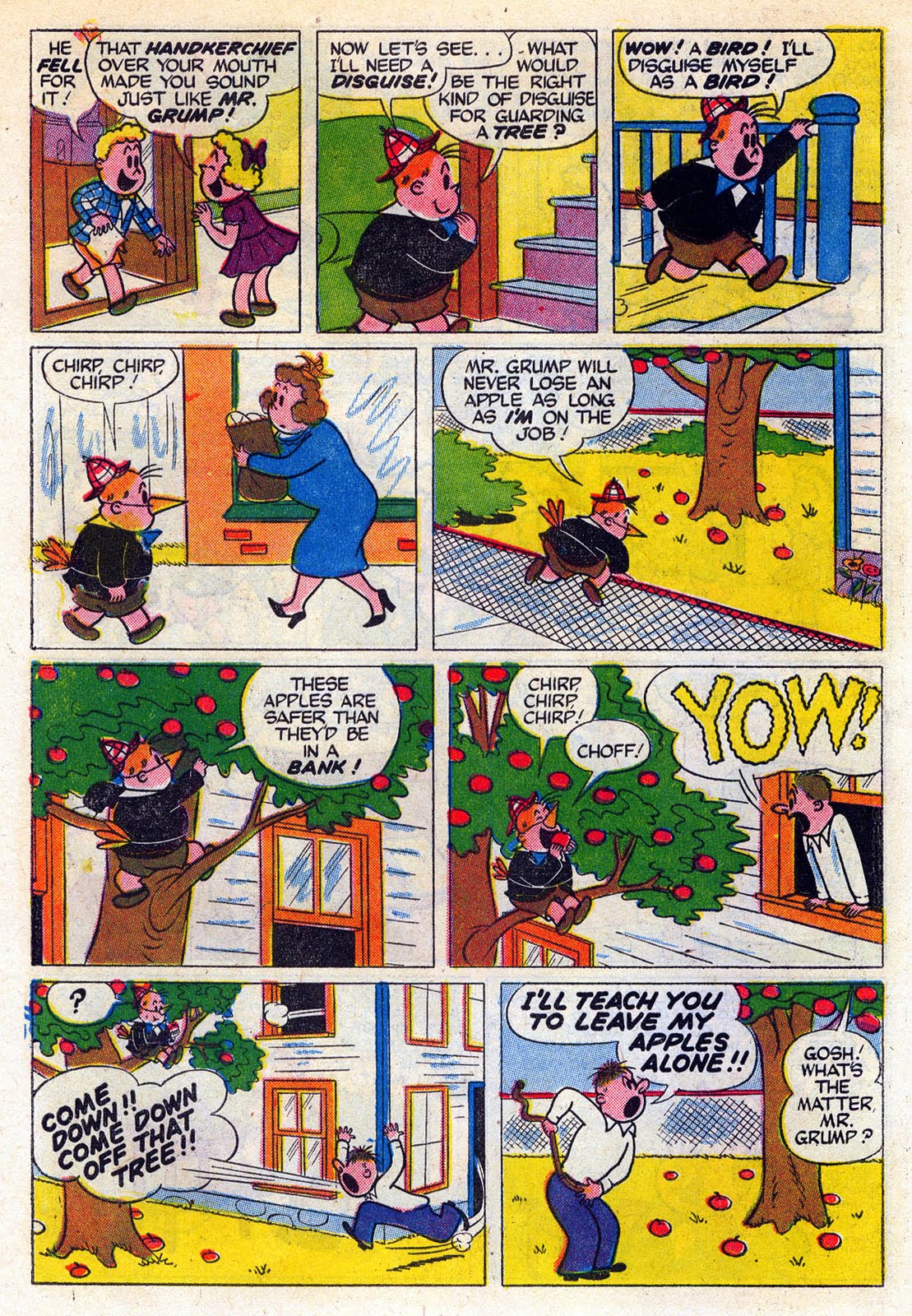
Here is a particularly creepy manifestation of this alienated loner-type--an ultimate TTO figure in the John Stanley universe. In this "Tubby" episode, the chips are stacked high against our anti-hero. The co-dependent TTO team of Wilbur and Gloria goad Tubby into an intense, dark encounter with "Ol' Mister Grump" in the story "Hide 'n' Seek."


The core of this story's dark comedy is Mr. Grump's single-minded destruction of his home. This startling feat is watched with great amusement by his "normal" neighbors, who continue to gawk as Grump is led away by The Authorities. (His non-sequitur exit line is, indeed, a comic gem.)
Stanley lulls us with a deceptive beginning. Tubby, deep in the self-role of TV-show private eye, entertains us as he calls for his lunch to be brought up to his room, and as he insults his mother about her physical looks. This is Tub in his prime--led by the nose by a fantasy that real life cannot, and will not, validate.
Tubby is dared to encounter Mr. Grump, whom Gloria fears so much she avoids walking by his home. Wilbur asks her why she's afraid of this "harmless" loner:

And, being the right bastard he is, Wilbur lays a quite dangerous trap for Tubby--one guaranteed to puncture his PI fantasy and place him in a high-stakes situation, where real physical harm could affect him.
Grump is more of a physical threat than McOnion. He wields a leather belt--that icon of mid-century childhood fear--and seems determined to thrash the daylights out of Tub.
He confronts and pursues Tubby through the warrens of his home, as his unreasonable rage builds to a dark crescendo. Frustrated, Grump finds release via the destruction of his home.
Something is Wrong-with-a-capital-W with Grump. The same applies to Sluggo's neighor-nemesis, McOnion. McO is all talk (and walk)--he verbally threatens a doom that never materializes.
Grump wants to cause malice. In this story, buried in an ordinary issue of Little Lulu, Stanley lets loose some of the darkest writing and characterization of his career.
Stanley was usually more cautious---and controlled-- in his authorship of Lulu. Perhaps he understood that this was a high-stakes venture: it was based on a popular, iconic cartoon character, done under the loose supervision of its less-talented creator, Marge Buell, and one of Dell Comics' big monthly sellers.
Thus, Stanley was less likely to take risks with this title. "Hide 'n' Seek" is a rare moment when his self-editor slips, and a startling amount of dark bubbles up to the sunny surfaces of Lulu-land.
The story's final frame, aside from the colorful babble of Grump, contains an adult authority figure who chastises the onlookers for their rubbernecking:

This seems to validate Grump's rage-fueled spree. Of course a guy might do this, when these damned nosey kids are around!
Whew!
Among the fascinations of John Stanley's work, for me, is the regulation of dark and light. There is often great tension in his work around this black-and-white disparity. "Hide 'n' Seek" represents a sort of comix exorcism--and one that got past the editors and out, in its undiluted form, to the Great American Readin' Public.
Stanley's 1960s works -- Melvin Monster, 13 Going On 18 -- are celebrated for their unremitting darkness. Quite honestly, nothing in either of those titles comes close to the pitch-blackness of "Hide 'n' Seek."
It is, like The Andy Griffith Show's Mayberry, a kind of Anglo-Saxon fantasy world, in which non-Caucasians are hinted at, but usually relegated to the background. They're never depicted as subservient or demeaning characters; they just don't exist, for the most part.
Such carefully orchestrated universes were comfort-food entertainment for post-war America. They seem, to me, to be a last desperate grasp at the idylls and ideals of pre-WW I American life--the final, faint traces of which could be felt in the background of post-war USA, especially in more rural, isolated areas.
Lulu is deemed safe reading for 21st century kids. To judge by what I've seen, these kids eat Lulu up with a fork and spoon and want seconds and thirds.
There is one gray area in Stanley's post-war Utopia that hangs darkly over modern parents: the depictions of physical discipline towards child characters by adults. I've spoken with several parents who mention that they have issues with the episodes of spanking that were stock parental activity in 1940s and '50s domestic life. (Spankings continued to be in wide use through the early 1970s, and perhaps later.)
Violent physical discipline is now taboo, and considered "trailer trash" behavior. (For shocking modern-day public displays of child-whipping, steel yourself and enter any Wal-Mart for as long as you can stand being there. 30 seconds usually does it for me.)
This aspect of Stanley's work is in the Dark Side. It is usually dealt with between parent and child. The threat of physical punishment is a stakes-raiser in many a Lulu story.
By the standards of their era, these punishments were acceptable. Now that parenting is more a negotiational act than a physical one, scenes of spanking have to be explained when Lulu is read by hipper kids in more hep households.
I was spanked as a kid. It left emotional scars, and a general distrust of the unpredictable whims of adults. I am glad to see that the majority of parents absolutely refrain from physical punishments, and favor negotiation or the use of consequences (i.e., "Stop hitting the wall with the croquet mallet now, or no more "SpongeBob" for the next week!").
Another physical threat exists for children in John Stanley's world: the alienated, sociopathic loner. This character is, sometimes, married (e.g., McOnion in Nancy and Sluggo), but typically lives alone, in a poorly-kept house, and has a name like "McGripe," "Krank" or "Grouch."
This presence is a fixture in post-war American pop culture. Perhaps the Kranks and McGripes were always there; maybe they were shell-shocked victims of wartime violence. Whatever the case, these off-kilter individuals usually lurk in the backgrounds of all sitcoms, domestic-themed comix, popular fiction and movies, well into the 1970s.
They are usually depicted as buffoons--barely tolerated misfits on the margins of "normal" society. They are talked about, subjects of gossip and speculation, but they are allowed to live on the edges of the suburban world.
Here is a particularly creepy manifestation of this alienated loner-type--an ultimate TTO figure in the John Stanley universe. In this "Tubby" episode, the chips are stacked high against our anti-hero. The co-dependent TTO team of Wilbur and Gloria goad Tubby into an intense, dark encounter with "Ol' Mister Grump" in the story "Hide 'n' Seek."


The core of this story's dark comedy is Mr. Grump's single-minded destruction of his home. This startling feat is watched with great amusement by his "normal" neighbors, who continue to gawk as Grump is led away by The Authorities. (His non-sequitur exit line is, indeed, a comic gem.)
Stanley lulls us with a deceptive beginning. Tubby, deep in the self-role of TV-show private eye, entertains us as he calls for his lunch to be brought up to his room, and as he insults his mother about her physical looks. This is Tub in his prime--led by the nose by a fantasy that real life cannot, and will not, validate.
Tubby is dared to encounter Mr. Grump, whom Gloria fears so much she avoids walking by his home. Wilbur asks her why she's afraid of this "harmless" loner:

And, being the right bastard he is, Wilbur lays a quite dangerous trap for Tubby--one guaranteed to puncture his PI fantasy and place him in a high-stakes situation, where real physical harm could affect him.
Grump is more of a physical threat than McOnion. He wields a leather belt--that icon of mid-century childhood fear--and seems determined to thrash the daylights out of Tub.
He confronts and pursues Tubby through the warrens of his home, as his unreasonable rage builds to a dark crescendo. Frustrated, Grump finds release via the destruction of his home.
Something is Wrong-with-a-capital-W with Grump. The same applies to Sluggo's neighor-nemesis, McOnion. McO is all talk (and walk)--he verbally threatens a doom that never materializes.
Grump wants to cause malice. In this story, buried in an ordinary issue of Little Lulu, Stanley lets loose some of the darkest writing and characterization of his career.
Stanley was usually more cautious---and controlled-- in his authorship of Lulu. Perhaps he understood that this was a high-stakes venture: it was based on a popular, iconic cartoon character, done under the loose supervision of its less-talented creator, Marge Buell, and one of Dell Comics' big monthly sellers.
Thus, Stanley was less likely to take risks with this title. "Hide 'n' Seek" is a rare moment when his self-editor slips, and a startling amount of dark bubbles up to the sunny surfaces of Lulu-land.
The story's final frame, aside from the colorful babble of Grump, contains an adult authority figure who chastises the onlookers for their rubbernecking:

This seems to validate Grump's rage-fueled spree. Of course a guy might do this, when these damned nosey kids are around!
Whew!
Among the fascinations of John Stanley's work, for me, is the regulation of dark and light. There is often great tension in his work around this black-and-white disparity. "Hide 'n' Seek" represents a sort of comix exorcism--and one that got past the editors and out, in its undiluted form, to the Great American Readin' Public.
Stanley's 1960s works -- Melvin Monster, 13 Going On 18 -- are celebrated for their unremitting darkness. Quite honestly, nothing in either of those titles comes close to the pitch-blackness of "Hide 'n' Seek."
Thursday, September 11, 2008
from "Melvin Monster" #8, 1967: an, er, yawning chasm...

I think I suddenly 'get' Melvin Monster, one of John Stanley's "auteur" comic book series of the 1960s. I recently picked up a complete run of the title (save #10, which is a reprint of the first issue).
Having read them, my opinion of the series has changed for the better. There is a great deal of inspired writing here. Stanley's bold, simple artwork (at times reminiscent of Dick Briefer's similar but looser work on the humorous Frankenstein comics of the 1940s) is a compliment to his concepts and dialogue.
Still, there are forbidding elements to this series that make it hard for me to embrace it completely.
Melvin Monster's is a grim, harsh world to inhabit. It is, however, consistent and well thought-out.
What bothers me about the series is the cruelty constantly hurled at Melvin, who is, at heart, a sweet and innocent being. Melvin is likable, despite being a goody two-shoes.
I'd love to see Casper, the Friendly Ghost or "playful" Little Audrey face the Spanish Inquisition. They represent the type of squeaky-clean, one-dimensional "goody two-shoes" characters that I can't help but dislike.
Melvin, on the other hand, is merely a non-conformist. He's the only nice guy in a world of monsters. It is a clever switch on the then-popular monster comedy genre, as seen on TV's The Addams Family and The Munsters.
Of course, to "sell" Melvin's niceness, it's necessary to make everyone else a raging, grade-A asshole. How else, logically speaking, would most monsters behave? Remembering that Melvin is the anomaly in this world can make its nastier elements a bit easier to stomach.
Melvin's parents, as I've commented elsewhere, really disturb me. Talk about your co-dependent, mutually abusive couple! It's Psych 101. You have the surly, prone-to-rage dad and the submissive, swimming-in-denial mom. So many American kids who grew up in the 1950s and '60s faced this set of parents. I certainly did, in my own way.
Perhaps John Stanley did, as well. These characters are too knowingly rendered, too forcefully present in these comic book stories. Despite Stanley's sharpness as a writer, the psychological weight of Melvin's 'rents leaves a bad taste in my mouth.
Ditto for Cleopatra, the alligator (or crocodile?) whose sole goal is to devour Melvin--a mission forever thwarted, thank goodness.
Anyway, here's "Supermonster," one of the more offbeat stories from an already offbeat series. Savor the mix of macabre themes, dry puns, and life-or-death struggles that distinguishes Melvin Monster in comix history.


Subscribe to:
Posts (Atom)