Sunday, November 21, 2010

John Stanley's World, pt. IV: Stanley's Soundscape


John Stanley's World:
Stanley's Soundscape

Comics, as a bridge between the written word and the moving picture, extensively utilize the former (as a necessity) and constantly suggest the latter. Although a silent medium, the comic strip or book has continued to compete with movies and TV, and hold its own.

This has been dependent on the developing vocabulary of onomatopoeia. Every WHOOSH, WHAM, SLAM and THUD (and their myriad variants) suggest the presence of sound, and abet the illusion of movement, in these fixed, mute boxes. They became a camp cliche in the 1960s, thanks to Marvel Comics' excessive, florid use of them, and via the network TV series Batman, which played up their cornball obviousness for comedic effect.

Even in 2010, when a newspaper (remember them?) runs a piece on comics, even if its subject is the most modern trends in non-mainstream material, chances are its unimaginative editor will have slapped a WHAM! or ZAP! into the headline. Onomatopoeia is a bedrock of the comics form. To many creators, it has been a necessary evil, to be used despite itself, or as a lazy way out of depicting complex scenes of action or destruction. (You could assemble a fat anthology of the off-panel CRUNCHes, BOOMs and TH-WACK!s that have occurred throughout the comic book's history.)

Others, among them John Stanley, embraced this sub-language of comics and brought it to the forefront in a vibrant and creative way.

Onomatopoeia was long a staple of newspaper comics. By the 1930s (the peak era of the continuity strip in American newspaper), several cartoonists made dramatic and highly visual usage of sound effects in their work. Roy Crane, Harold Gray, V. T. Hamlin, Chester Gould and Dick Moores come immediately to mind.

The concept of sound effects as a decorative, attention-getting element in the comics was clearly fixed before 1930, but these and other artists brought them to the fore and made them a component in the design of their panels, etc.

In the 1940s, comic books' use of onomatopoeia was all over the map. I've chosen three examples from 1940-44 comic magazines to show the spectrum of styles.

Some creators opted out of sound effects, as in this excerpt from the "Superman" story in Action Comics #27, 1940:
The absolute lack of SFX from these scenes of bending metal and ripping wood seems rather eerie. Author Jerry Siegel seldom used onomatopoeia. His stories tend to have a solemn feeling for their absence.

This panel, from Mystery Men Comics #7 (1940) shows the most common usage of sound effects in comic books. This is what the average person thinks all comic books are like:

Some early comic book creators made creative use of onomatopoeia--Will Eisner, Sheldon Mayer, Joe Simon & Jack Kirby, Dick Briefer and, most significantly, Jack Cole. Cole reveled in sound effects, and made them a vital part of his narrative and visual landscape. Typical of his mid-1940s use of onomatopoeia is this page from Plastic Man #2, 1944:
Cole's use of sound effects as a visual element would become more baroque in the late 1940s. (You can read a truckload of Jack Cole stories--and intelligent commentaries on them--at Paul Tumey's fine blog Cole's Comics. Paul, in fact, suggested the topic of this essay. Thanks, Paul!)

Onomatopoeia was warmly embraced at Western Publications (creator and packager of Dell's popular comics line). Its three major "star" artist-writers -- Walt Kelly, Carl Barks and John Stanley -- leaned on them extensively in their earliest stories.

Most conservative in his use of onomatopoeia was Carl Barks. Here's a chosen-at-random page from a 1944 "Donald Duck" story (Walt Disney's Comics and Stories #48). The two instances of SFX are vibrant but measured. They're here to serve the story--not to call attention to themselves.


Onomatopoeia was to Walt Kelly what a wallow is to a hog. Kelly used its devices as a kind of music, in concert with the florid, playful dialogue (and dialect) of his archly comedic characters. Here's a robust example from Animal Comics #9, also 1944:

Each BOO RAWP, OOP, ULP and CLANK are exultant to Kelly. Kelly's onomatopoeiac joy seems to have made a strong impression on John Stanley, as he began his comic book career.

From his first comics story...

to his last...

onomatopoeia, volume variance and SFX presentation are an essential part of John Stanley's comedic universe. How Stanley used onomatopoeia tells a story of its own, throughout his almost 30-year career in the American comic book.

Stanley's personal contributions to the language of comics include the following:

 ZAZ (and its cousin, WHAZ)
this effect was used in the late 1940s, then abandoned until the late 1950s. ZAZ becomes one of Stanley's major onomatopoeia choices in his 1960s efforts.

CHOFF (and its derivative, CHOMPF)
 Stanley used CHOFF through-out his career. It's associated with Tubby Tompkins in Little Lulu, but all of Stanley's characters (those who ate greedily or for a comedic or stakes-raising purpose) choffed or chompfed their way through their comestibles. (Choff is used as a verb, at least once, by Stanley; see for yourself HERE.)

KRAAAKL (in various spellings and configurations):
Most often used in Stanley's Little Lulu and Tubby stories, this sound effect connotes either gluttony or a sort of autism associated with liquid consumption. As seen in this example from Dunc 'n Loo, it often has an annoying effect on its target.

It may surprise readers to learn that YOW is not a Stanley creation. Stanley certainly made it his own. There are many YOWs in comic books, comic strips and animated cartoons before Stanley's first usage (as the derivative YOWEECH) in his first comic book story, which you can read HERE.

One could wallpaper a room with all Stanley's uses of YOW, throughout his comics career. It's his one-size-fits-all exclamation. It can connote:
FEAR

SURPRISE or SHOCK


ANGER
PAIN

JOY or EXCITEMENT


YOW is the mantra of the John Stanley character. It is all things to all people, animals or supernatural creatures.

YOW is not an automatic guarantee of John Stanley authorship--especially in post-1950 Dell comics. As I've discussed here before, Stanley's writing 'tics' were often adopted by less creative writers who also worked for Western Publications.

One Western staffer, Dick Hall, was greatly influenced by John Stanley's approach to comics. Hall was among the creators who took over Stanley's berth in Walter Lantz New Funnies in 1948.

According to the research of comics historian Alberto Becattini, Hall (who, I think, wrote his own material) had previously done the first two Woody Woodpecker one-shots, published in late 1947 and early '48. He also did some Stanley-esque stories, featuring the Lantz characters, for the March of Comics giveaway series produced by Western.

Hall deserves some props as a comics creator. Like Stanley, he was a journeyman. He worked for Lev Gleason, Hillman and, later, Gold Key. He fashioned a distinctive style, based on Stanley's work, and continued to write decent material into the 1950s. I'll do a separate post on Hall someday soon.

As Hall and others demonstrate, the affect of Stanley was imitable, but the soul and substance of his writing were not. Others could simulate Stanley's visual-verbal cues (YOW and such), approximate the frenzy of physical action and energy seen in Stanley's work, and still come up short.

That Stanley's vision was innately commercial is borne out by the influence his style had on Western in the 1950s. Until 1957 or so, when Stanley's writing and approach began to shift into a brassier, bolder mode, a superficial simulacrum of his comics style occurs constantly in the East Coast-produced Dell titles.

Another tic of Stanley's, used by all cartoonists, past, present and future, is his "Ha! Ha! Ha!" The way Stanley uses this device--to connote scorn, disapproval, social humiliation or triumphal revenge--distinguishes itself in his work.

John Stanley was among the few comics creators to combine creative onomatopoeia with a suggestion of volume, tone of voice and atmosphere. While this trend is seen throughout his career, it moves to the forefront--with a series of refinements--beginning in 1955.

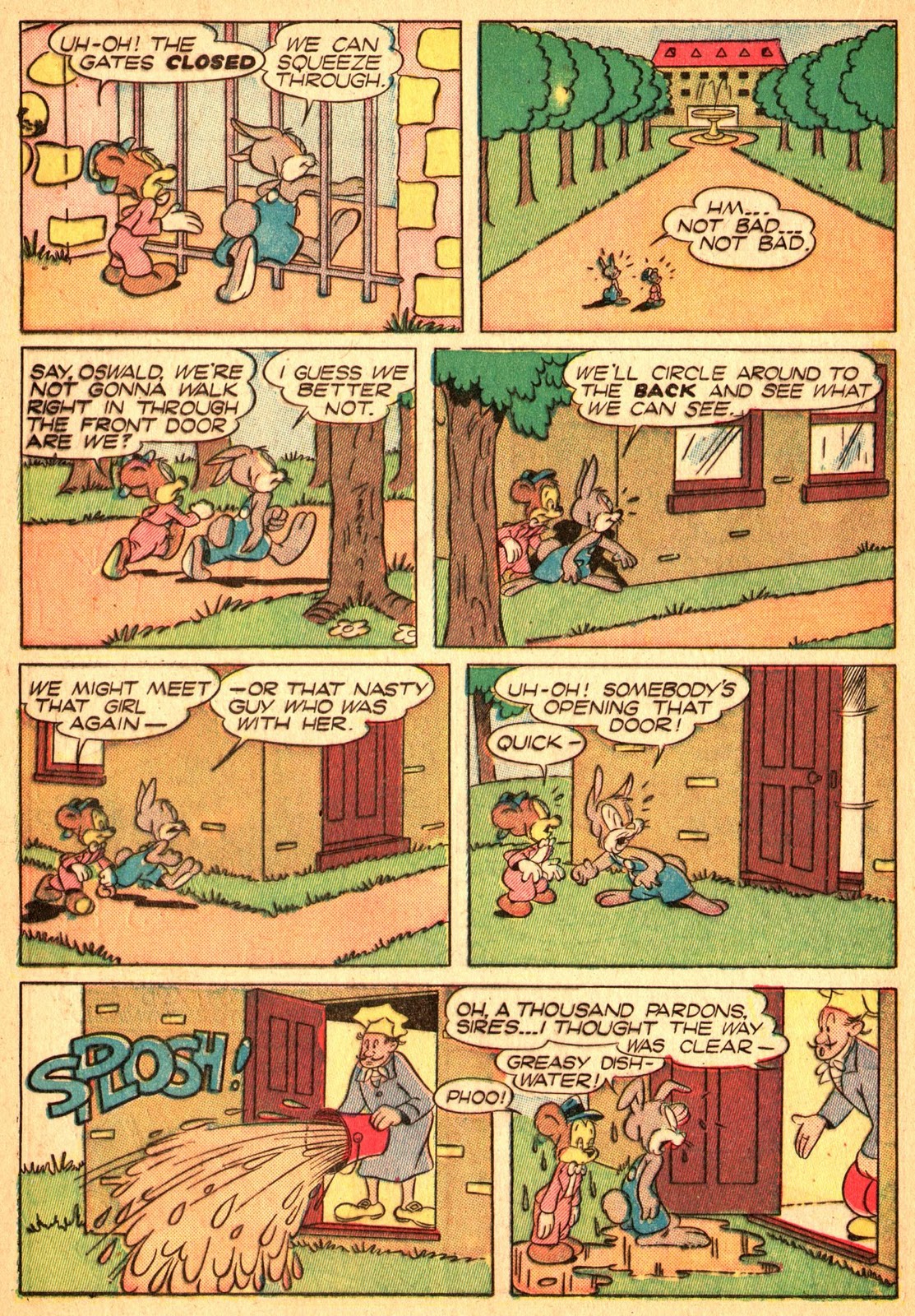
Stanley's 1940s funny-animal work often affects a brassy, strident tone, as seen in this 1947 "Oswald Rabbit" page from Four-Color #143:
We see four distinct levels of voice tone on this page--from normal speech to ecstatic shriek. Combined with frantic physical action, this page is analogous to a scene from a Preston Sturges movie. These are loud comics.

Stanley tamped down these tendencies, on occasion, as the creator of Little Lulu. For stretches of his earlier Lulu stories, there are three voice-tones: normal speech, emphasis speech and emotional exclamations. All three tones are seen on this page, picked at random:
The overall feel is similar to Harold Gray's Little Orphan Annie of the late 1920s and early '30s. The volume is mostly "indoor voice," but outbursts are allowed for dramatic effect or narrative emphasis.

Stanley was inconsistent with his self-imposed rules. Even in the "quiet" period of Lulu, there are outbursts of hooliganism. Here are two examples, from Lulu #14 and 24, published in 1949 and 1950:
These pages are typical of Stanley's work, throughout his career. He never lost his fondness for aggressive shifts in volume, or for making his onomatopoeia jump off the page. That said, outbursts like this are less common in the Lulu of 1948-53 than elsewhere in Stanley's comics career.

The less flamboyant Lulu grounded Stanley as a writer--and provided his breakthrough to mass-market popularity.

The dialed-down tone of Little Lulu allowed Stanley to, for the first time, truly inhabit the skin and bones of his characters. He had written compelling character-studies before Lulu, most notably in his "Woody Woodpecker" stories of 1944-47. With Lulu, Stanley learned creative discipline. He had to. He was in charge of a major licensed property, and entrusted by the character's creator to do the right thing.

Boiled down, by 1949, into a series of bullet-proof story formulas, Stanley's Little Lulu rivals George Herriman's Krazy Kat and Chuck Jones' Road Runner animated cartoons as an exquisite expression of endless variations on a set of rigid themes.

Although this approach is more often borne of cynicism and mass-production, it can bear great riches in the right hands. Stanley used repetition of themes and incidents to solidify and deepen his characters. Thus, they felt real to millions of faithful readers.

Such discipline was not easily sustained. In his side-projects of the '50s, such as Krazy Kat and his eight-issue run as artist-writer of Tubby, Stanley let his wilder, looser sensibilities run rampant.

Compare these August, 1951 pages from KK #2 and  LL #34 :

Although the events in the LL page are far freakier than those on the KK, the difference in their energy is striking.

Both are recognizable as Stanley's work. It becomes clear that the characters themselves dictate the energy of the work. The usually unflappable Lulu chills out everything around her.

Stanley's antic re-imagining of Herriman's Kokonino Krew gave him a runway for his humor's inherent frenzy. Characters are physically and emotionally affected by their surroundings, and by the actions of others. Though the stakes are far higher for Lulu (becoming a "cute ghost"), Krazy's burrow into Offisa Pupp's living room is treated as a much bigger event--with more movement and noise.

As Stanley increasingly relaxed into Little Lulu in the 1950s, more of his true nature rises to the surface. The eight issues of Tubby he wrote and drew seemed to revitalize him. After 1954, the dry, tight tone finally leaves Lulu. Stanley's truly masterful comics period begins.

Harbingers of this mature style could be seen here and there. Here's another comparison of two contemporary pages--one from the fourth Tubby, the other from Little Lulu #58--both with April, 1953 publication dates.

These 1953 pages are more energetically matched. Stanley's artwork, on the first page, teems with energy. Irv Tripp's page, below, doesn't. But the events of the pages, and the reactions of the characters--and the variance of volume tones--are quite close.

The Lulu page is, in fact, louder than the Tubby. This is the template for the general intensity-level of Stanley's mature period. The mature Stanley has enormous range--from a whisper to a tsunami. The range isn't as extreme in either of these 1953 pages, but it's markedly different from the diffident approach of the 1951 Lulu page.

This '53 page has another career-spanning Stanley sound signifier: the placement of a sound effect in a speech balloon. Stanley used this affect often in the first two years of his comics career, and then soft-pedaled it for a few years. It is fairly common in his '50s material--most significantly in his eight self-drawn issues of Tubby.

Here's an example from Stanley's second "Andy Panda" story, published in 1943:


In the early 1960s, Stanley made the SFX-in-balloon one of his major stylistic tics. It's constant throughout his comics work...

This device, though downplayed during the austere Lulu period (1948-1953), never quite left Stanley's arsenal. It's a distinctive way to weave sound effects into the comic book story's fabric. I can't think, offhand, of another mainstream comic book creator of this era who used this technique.

Gilbert Shelton put sound effects into balloons in his early 1960s Wonder Wart-hog stories. He continued using this device through the 1970s and '80s. I can't recall if the last new work I've seen of his, Not Quite Dead, still features SFX-in-balloons.

It is memorably used by Stanley and Shelton to dryly underscore the monotony, futility or absurdity of their characters' actions. The traditional manner of showing SFX--as bright, bold, aggressive "floating words"--makes them seem like they're happening despite the presence of the characters. Stanley's ballooning makes a case that the SFX occur because of the characters' actions. The SFX are more intimately tied to the action via this enclosure.

Stanley also used specificity to make his sound effects funnier. As early as 1944, Stanley was hep to the potential of this specific-SFX comedy:


By the 1960s, repetition of common SFX, alone or in groups, was a major source of Stanley's comedic sense and of his timing:


Compare these three 1960s pages to the "quiet" period of Little Lulu. These offer a much more expressive soundtrack to the reader. Characters (and inanimate objects) raise their voices, act out more often, up the stakes of their narrative, and make a lot of racket in general.

Shouting matches started in mid-1950s Little Lulu. For comparison's sake, here is an argument sequence from 1949, and another from 1956:

In the 1949 sequence, the boys have a discussion that allows for several potential levels of volume--from normal speech to retorts to defensive response. It works because of the quality of the writing, and Stanley's growing investiture in his characters.

The 1956 page offers four visual levels of volume, and implies a much livelier "sound" overall. The reader is invited to "hear" the inflections of Lulu and Annie's speaking voices. Stanley is so deep into these characters that he can direct us to read these changes in tone on the silent printed page.

A fine example of Stanley's mastery of his comics soundscape is "Camping Out," from the last issue of Dunc 'n Loo, published in 1963. Collaborator Bill Williams really got Stanley's concepts on sound volume in the comics page. Oh, projectionist...


Sound effects and atmosphere are as much the stars of "Camping Out" as Dunc or Loo. This story shows Stanley on his A-game as both entertainer and sound technician. 

At this peak, Stanley achieved an alchemy of sound and silence not before seen on the comic book page. His innovations in comics sound, throughout his career, are as significant as his narrative or character-building skills. All these elements work together to distinguish his comics creations.

Gilbert Shelton, as I've said before, seems to have inherited this mantle of comics' foremost "sound man." But John Stanley, to the best of my knowledge, exploited sound, in the mainstream comic book, better and more thoroughly than anyone else.

You don't just read a John Stanley comic--you also hear it in your head. Its sounds are richly orchestrated, and add value to even the simplest of plots and conflicts.

Sunday, November 14, 2010

Rabbit, Bear Induce Fugue State of Time-Travel While In Antique Shop: "Oswald Rabbit" from New Funnies #123, 1947

Spoofing the ways of the past is a staple of American comedy. Mark Twain's A Connecticut Yankee in King Arthur's Court, which was published in 1889, may not have been the first American work of its kind, but it established a template that has stayed with us.

In the 1930s and '40s, it was fashionable to poke fun at the Gilded Age of American life. S. J. Perelman, John Held, W. C. Fields and other major comedic voices did it with relish. Fields' movies The Old-Fashioned Way and the two-reeler The Fatal Glass of Beer are brilliant examples of this comedic trend.

This would be equivalent to us spoofing, say, post-war America--except that the world isn't as fundamentally different between 1946 and 2010 as it was from 1888 to 1935. Sure, we have cybernetic doo-dads out the wazoo. People beeble and booble and bleep their way through each day, aided by a battery of portable gewgaws that no one really needs, but that everyone desires to own and use.

Many of our modern marvels are just modernizations of innovations made in the early 20th century. An iPhone is still just a telephone; a PC or a Mac is essentially a typewriter with a picture tube; plasma TVs are still just television sets.

We haven't had anything as game-changing as the automobile, airplane, telephone, motion pictures, recorded sound, et al, in our lifetime. Heaven knows, I'm no expert in such matters. It would seem that the greatest strides made since, say, 1950 have been in space travel (on the big end) and health care and medicine (on the everyday level). (Thad K. reminds me to mention the Internet. I forgot the Internet. There's high-grade irony for you.)

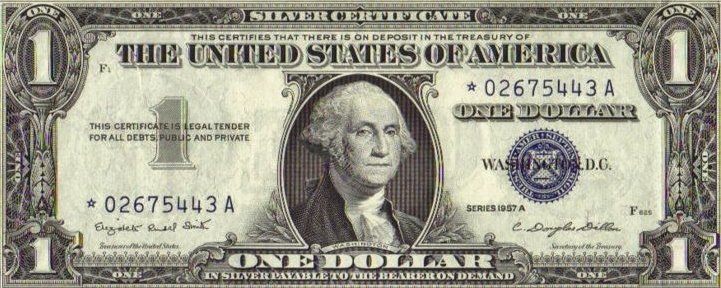
2010 Americans would not find post-war America an alien place. With a careful choice of retro clothing and a pocketful of silver coinage and silver-standard folding money (the kind that actually states it's worth something, as seen here)...


a 2010 person could convincingly roam the streets of 1948 America (although most would be bored to tears within 90 seconds).

To humorists of the '30s and '40s, the ways of the 18th and 19th centuries were a carnival of hilarity. The elaborate dress, the florid language, the courtly behavior, the rituals of social life, and the chaste nature of romance seemed alien, cornball and insufferable.

John Stanley trafficked in this trend of fun-poking at the past and its quaintness. He chose to go back to the 18th century. This ties in with popular culture's contemporary fascination with period dramas--in which the past is taken very, very seriously.

Novels such as Kathleen Winsor's 1944 Forever Amber were huge best-sellers in wartime and post-war America. In the 1940s, Hollywood was in the midst of a decades-long love affair with Ye Olden Times. Movies as diverse as Hangover Square and Gone With the Wind painted elaborate portraits of the lifestyles of yore.

Stanley chose the costume-drama era, rather than the Gilded Age, for his comic book spoofs. Like Perelman, Fields and Held, he emphasized the excess and needless courtliness of those bygone days. Stanley makes the same point in his spoofs: isn't this just too much? Why on earth did these people go to so much fuss and bother?

In New Funnies #99, his "Woody Woodpecker" story has the bird reading a book on the subject...

Woody has a more conventional dream sequence here, as you can see. He makes a burlesque of olden manners, including the gentlemanly art of the duel. He  humiliates his duel partner--and picks his pocket for good measure.

At story's end, Woody returns to consciousness, and the present. He addresses the reader, with obvious self-satisfaction:


This untitled story is quite amusing. It's loaded with energy, wordplay and wit. John Stanley was on the start of his learning curve as a writer in 1945. Two years later, he returned to this spoof-the-Gilded-Age turf in New Funnies. This time, he adds extra layers to the scenario. As with my favorite Stanley story, "The Guest in the Ghost Hotel," this story's occurrences walk the fine line between reality and fantasy. 

Notably, this story starts with rainfall--always an agent of change in John Stanley's world.


Loaded with clever humor, farcical action, and higher stakes than the "Woody" story, this "Oswald" piece benefits from twice the page count. Stanley has time to indulge his loves of wordplay and broad physical action. He sets up an elaborate, rather intellectual gag sequence (on pp. 4-5), in which the town crier includes an oral comics section in his news broadcast.

The Thurber-esque look of the male human characters is typical of Stanley's 1946 and '47 work. I would assume Stanley was an admirer of Thurber's. I don't know if the decision to sorta-ape Thurber's cartoon style was Stanley's, or that of the unknown artists who worked on New Funnies in this period. Whatever the case, there are many occurrences of faux-Thurber in Stanley's post-war New Funnies work.

Most noteworthy in this story is the transition from 1947 reality to that of the gilded past. There is no dream sequence signifier. The antique dueling pistols bring the cuddly duo to the past; a falling chandelier literally smashes them back to present-day.

It is the characters' dialogue--and their imaginations--that put them in this timeless state. Therein, they're free to act out, 1947-style, in a world they don't understand. Oswald and Toby are somewhat informed by the knowledge of the past they've picked up from costume-drama movies and whatever pop fiction they've ingested.

Of course, their standard-issue 1940s behavior now seems a bit quaint to us in 2010. This adds another, unintended layer to the story's functions.

Carl Barks achieved something similar in his 1951 story "Donald Duck in Old California." He, too, used something more than a mere daydream to transport his characters to a very real, solid past. Barks plays things much more straight than Stanley, but he also gets some comedy from cultural incongruity--from how much things have changed in 100 years.

The way Barks brings his characters in and out of the past is far more elegant and elaborate than Stanley's devices here. Of course, Barks had over twice the page length accorded Stanley in today's offering.

If you've never read "In Old California," which is among Carl Barks' greatest achievements in comics, you can peruse it on-line HERE. These two stories allow a rare window to intensely compare the storytelling styles of Carl Barks and John Stanley.

Though I still consider Stanley the superior creator, for many reasons, I don't deny Barks' skills as a storyteller or cartoonist. They came, literally, from different places--Barks from the Pacific Northwest and Stanley from the Northeast.

The approaches of these two stories are tellingly different in that regard. Barks embraces a specific, deeply felt locale, and renders it lovingly. In "Old California," the landscape is the unspoken star of the story.

Stanley, focused on his characters, merely sketches in a broad background and lets it function as a backdrop to the action. Historical accuracy is obviously not a concern of his. He gives the reader just enough to coast on, and lets his characters and their motivations run the show.

With this final thought, I'll seal the cork on today's missive, and toss it upon the vast waters of the Internet...

Sunday, November 7, 2010

Towards A John Stanley Top Ten: The Tao of Yow! (pt. 2 of 2)

To choose the best of John Stanley's un-reprinted stories is a bittersweet affair. Most of these stories will remain un-reprinted, due to their characters being owned by greedy megacorps. These conglomerations generally won't bother unless they're guaranteed megabucks. Otherwise, materials that feature their copyrighted properties languish in limbo, known only to nuts like myself who bother to shed light on them.

The good news is that some of these choices will see the light of reprint, in time. The 1940s and '50s licensed-character material of John Stanley, with the exception of Little Lulu and its satellite titles, has stayed in the dark since its first (and sole) comic-book publication.

The freedom that Stanley took with these characters may have doomed these stories. Stanley retooled the characters, gave them tangible personalities, and had them do things that would have been way, way off-base for their standard print and screen versions.

That Stanley's re-imaginings of these licensed entities far outshines their official versions is a blessing for us, who enjoy this work, but a hindrance for modern-day attorneys and CEO-types who want to maintain a bland, wholesome mainstream image for their holdings.

Universal Media will never do anything with Andy Panda, but I'll bet they'd cringe at the idea of Andy threatening his room-mate with death. Ditto for the struggling, opportunistic loner who is Stanley's Woody Woodpecker, the garrulous, philosophical mice in his version of Tom and Jerry, and the equally verbose, self-absorbed take on Otto Soglow's The Little King.

This list will exclude any "Little Lulu" and "Tubby" stories. Those will all be reprinted within the next few years. Ditto for Stanley's Thirteen Going on Eighteen, Nancy and Melvin Monster. I cannot exclude the yet-to-be-reprinted Dunc 'n' Loo, which Drawn + Quarterly will, in time, return to currency.

Thus, most of these picks will be from the 1940s and '50s. My criteria for these stories is not their date, but their content. I believe each of these ten pieces shows a side of John Stanley at his best and most inventive as a writer and/or cartoonist.

As before, if I have overlooked one of your favorite pieces, please interact and let me know. I'll be glad to update this list with your suggestions.

And now, in no particular order...

<><><><><><><><><><><><><><>

"The Secret Six" (Dell Four-Color #67, 1945)

Funnybook terrorism, condemnation of the super-rich, and cuddly funny animals combine in John Stanley's first major long comics narrative.

This particular issue is a John Stanley career milestone. Its two stories feature Stanley's first supernatural character (a proto-Witch Hazel) and the first of his Evil Rich.

The antagonist, D. J. Rarebit, is a wartime Dick Cheney--a business tycoon whose corporate knavery has endangered his life.

Gentle, kindly lookalike Oswald the Rabbit is hired to double for Rarebit, unaware of the darker dealings of the scion, or of his hit-list status.

By simply treating Rarebit's broken staff with fluffy good will, Oswald brings joy to a joyless world. In one of Stanley's most Frank Capra-esque sequences, Rarebit's rattled staff rejoices in being regarded as sentient beings with feelings and needs.

The darkness of Rarebit's fate soon displaces the fuzzy wuzzy funtime of Oswald and his playpal/partner Toby Bear. Ultimately, fate deals a karma-coated dose of justice to Rarebit--of which Oswald and Toby are only vaguely aware.

"The Secret Six" is quite complex, and takes genuine risks with its licensed properties and with the whole notion of "kiddie comics" and their air of harmless fun. This is storytelling with real cojones, and it deserves to see the light of day.

"Oswald the Rabbit" (untitled, Walter Lantz New Funnies #124, 1947)

John Stanley achieved a droll blend of slapstick and sitcom in his later stories for the long-running Dell title New Funnies.

By 1947, his last year on the title, the sophistication and strong humor of Stanley's work in New Funnies was quite striking.

The narrative stakes-raising that propels Stanley's Little Lulu was born in the pages of New Funnies. As well, a genuinely loopy, unpredictable sense of absurd humor is present.

In this, one of John Stanley's wittiest and funniest stories, Oswald and Toby have their domestic bliss shattered by the neurotic magician The Great Marvo.

Marvo honors Toby's bizarre request to become a... well, I don't wish to spoil the surprise if you've not read this story. I don't think anything wackier has even happened in the pages of a mainstream comic book. Snappy artwork by Dan Gormley sells Stanley's sizzle and narrative stakes 100%.

Once again, this untitled story transcends the expectations of "kid comics" by miles and miles. I regret that this vein of absurd humor gradually ebbed from Stanley's work in the 1950s.

John Stanley's "Woody Woodpecker" one-page gags, Walter Lantz New Funnies #121-131, 1947

Eighteen filler gag pages, written and drawn by John Stanley during a period when he pursued a berth as a cartoonist-writer with Western Publications; a red-hued catalog of Stanley's growing sophistication as a cartoonist--and as an effective storyteller and humorist.

I am certain Universal Media would nix these pages, for several reasons. They go off-model with a vengeance, and Woody is given to vividly anti-social behavior in several of the 18 (including this, the first of the run).

These gag pages show the apparent influence of the great cartoonist Milt Gross, plus some echoes of the brilliant theatrical cartoons of Tex Avery and Chuck Jones. There's even a touch of James Thurber (as is common for Stanley's 1940s cartooning).

You can see the entire run at the link above. These rival that famous hell-bound snowball in terms of being reprinted. 'Tis a pity, but that's the way it is.


Around the Block With Dunc And Loo/Dunc and Loo (8 issue series, Dell Comics, 1961/3)

This is not a Draconian choice. It comprises some 280 pages of comics, all of it brilliantly brought to life by cartoonist Bill Williams.

Dunc and Loo is, by far, the most appealing of John Stanley's original comic book creations. Though it lacks the emotional depth of Thirteen Going on Eighteen, or the dark dysfunction of Melvin Monster (qualities that define and distinguish Stanley's 1960s work for many of his admirers), Dunc is easier to embrace.

Its connections to the urban worlds of Stanley's 1940s funny-animal stories, to Little Lulu, and to Stanley's curious take on Nancy and Sluggo, makes Dunc and Loo perhaps more palatable than Stanley's later work.

Stanley was blessed with the collaboration of Bill Williams. They'd first worked together in 1950 on Dell's Henry Aldrich comic book series. Stanley and Williams worked up some unsold newspaper strip concepts (shared with us by Stanley's son James in THIS post) which ultimately became part of the D&L universe.

Status comedy, stakes-raising, down-to-earth narratives, social embarrassment, broad but appealing characters (akin to those in Nat Hiken's vigorous TV sitcoms Sgt. Bilko and Car 54, Where Are You?) and a well-defined, slightly claustrophobic lower-class urban landscape all distinguish Dunc and Loo.

Stanley's prior experiment in the teen-humor genre, the two-issue Kookie, can be lumped in with Dunc and Loo's eight issues. A Max Shulman-esque, farcical look at the Greenwich Village world of espresso houses, beatniks and art chicks, Kookie (also with superb cartooning by Bill Williams) was given the ax before it even had a chance to breathe.

Kookie is a strong improvement over the occasionally brilliant but uneven Nancy and Sluggo. Perhaps its characters were too out-there for 1961 readers. With Dunc and Loo, Stanley found his niche as a teller of sophisticated, bright sitcoms on paper. Peppered with creative uses of typography, clever yet utile page layouts and boundless energy, D&L ranks among John Stanley's finest work in comics.

Due to an eventual reprint volume by Drawn + Quarterly, I've held off on running many stories from this series here. If you haven't prowled around this blog too much, I'll be a sport. This link takes you to a Kookie story; these 'uns will land you in Dunc and Looville.

The Little King (three Dell Four Color one-shots [494, 597, 677], 1953-56)

The 1950s were John Stanley's most even-tempered years as a comic book creator. The enormous success--and responsibility--of his tenure on Marge's Little Lulu and Tubby caused Stanley to power down on his wilder impulses as a storyteller.

Little Lulu was just right for post-war America. It had just enough brass, sass and personality to become a mainstream smash. Simultaneously, its characterization, narrative stakes and linguistic richness brought out Stanley's best as a writer.

Lulu was series fiction, run by a number of formulae. By 1953, Stanley simply filled in the blanks on a set of story templates (Lulu tells Alvin a story; Tubby tries to woo Gloria/trick Lulu/frustrate Wilbur; Tubby solves a 'crime' in the Moppet household; Tubby torments the universe with his bad violin playing).

What might have been cynical hackwork became richly nuanced, solidly character-driven mainstream storytelling of the highest order. It took a mix of discipline and innovation to run the good ship Little Lulu, as Stanley did for thousands upon thousands of never-phoned-in pages.

This discipline applied to the smattering of non-Lulu comic book work Stanley achieved in the 1950s. The finest, by far, are the trio of one-shot comics featuring Otto Soglow's King Features Syndicate-owned entity "The Little King."

As he did with most copyrighted properties in his path, John Stanley took the good aspects of Soglow's set-up and characters, tossed out the rest, and modeled it to best suit his strengths as a storyteller. Stanley's Little King is endowed with the classic quirks of what I call "the Tubby type." I've written extensively about this character archetype HERE, and don't wish to repeat myself.

Among the best of these stories is "The Search," which may be found in the link embedded in this entry's title. Stanley mines great comedy out of one character's quest for the inconsequential, and creates a strong character-based story arc that resolves plausibly and charmingly.

"Raggedy Ann and Andy" (untitled story, Raggedy Ann and Andy #36, 1949; story and art by John Stanley)

Among the most curious of Stanley's comics assignments were the handful of "Raggedy Ann and Andy" stories he wrote and drew in 1949. Simultaneously, Stanley also wrote and drew his original creation, "Peterkin Pottle," for the magazine.

The Munchhausen-esque Pottle took the cover and lead spot in the Raggedy Ann comic book for seven issues. Hidden inside their own magazine, Stanley's "Raggedy Ann" stories are a final burst of wild imagination before the restraint and control of his 1950s work.

These stories presage what would be Stanley's lone outpost of freeform fiction in the '50s--those improvised fairy tales, told monthly to bratty neighbor Alvin by long-suffering Lulu Moppet. Stanley delivered these stories like clockwork, issue after issue. All of them contain at least one brilliant narrative concept. At their best, they tackle dark themes adroitly and pursue sky-high narrative stakes.

That said, the protagonists of these fairy-tales never died. In this jaw-dropping "Raggedy Ann" story, the two sentient dolls consume poison mushrooms and expire. Their misadventures in a defective, mischief-riven Heaven bring them back to life on Earth, none the wiser for their ethereal exploits.

All of Stanley's "Raggedy Ann" stories are fine, and a few, this included, show him at his best as both artist and writer. This story's treatment of death, afterlife, and resurrection is, I believe, once again unique to mainstream comic books.

I'm sure that Hasbro, Inc. and Simon and Schuster, the current owners of Johnny Gruelle's Raggedy characters, would heartily disapprove of the concept, execution and publication of this 1949 story in 2010.

O. G. Whiz #1 (Gold Key Comics, 1971)

John Stanley's final work for comics, O. G. Whiz offers one final dose of his intense, verbose, intelligent comedy and storytelling.

Had Stanley not soured on further work in the comics field, O. G. Whiz might have been a final successful run for him as a creator. Its concept is brilliant (and entirely original). The stakes, density and zaniness of the four stories here are rich and inspired.

James Stanley has mentioned that his dad was fond of some of the underground comics of the 1970s, and that he was a regular reader of the classic National Lampoon comics section of the era.

There seems to me to be a strong connection between late Stanley and the best work of underground writer-artist Gilbert Shelton. Whether this is coincidental or not, this likeness is particularly strong in these last four comic-book stories of John Stanley's long career.

You can read the entire contents of this final Stanley work HERE and HITHER.

"Woody Woodpecker" (untitled, New Funnies #93, 1944)

Among Stanley's first comic book stories is this vivid, harrowing nightmare narrative.

As in "The Secret Six," dark, threatening imagery runs rampant here. The uncredited cartoonist does beautiful work here, and brings the frightful, accelerating dream-narrative of the addled bird to full life.

This story also introduces the truant officer to John Stanley's world--ultimate threatening authority figure to comic book children of any genus.

Among several outstanding "Woody Woodpecker" stories written and illustrated by Stanley in 1944, '45 and '46, this is a peak effort. You can read it HERE. Several other '40s Woodpecker stories are salted throughout this blog.

"Tom and Jerry" (untitled, Our Gang Comics #47, 1948)

Tom and Jerry was the first series John Stanley wrote for comic books. He did two runs on this series. In the first one, which spans from 1943-45, we see him developing as a comics writer.

Towards the end of that first run, Stanley hits some homers. The starkness, vividness and general impact of his storytelling, characterization and comedy sense makes a quantum leap in these early efforts.

Stanley returned to "Tom and Jerry" in 1947 and '48. His growth as a writer, and his rich ability to write from well-wrought characters, is strongly felt here.

This story is, notably, free of the character of Tom Cat. As with many of Stanley's "Tom and Jerry" stories, the conflict-based, violent attitude of the Hanna-Barbera cartoons is discarded. Stanley is far more interested in the two mice, and in their Quixotic explorations of the big world of human beings.

A quiet poetry emerges in this untitled story, which is written with sharp wit and great charm. The uncredited cartooning, which may be partially by Harvey Eisenberg, shines as well.

Because John Stanley's "Tom and Jerry" stories take such particular liberties with the flawed premise of the original, I doubt that whomever currently owns the property would feel these stories were worthy of reissue. Several strong examples of Stanley's "Tom and Jerry" can be found in this blog.

Read this story HERE.


John Stanley's New Yorker gag cartoon, printed in 3/15/1947 issue

The sale of this gag cartoon to The New Yorker, acme of the cartoon market in the 1940s, was John Stanley's most prestigious career moment. Why he didn't do more for the magazine remains one of the unsolved, unanswered mysteries of his life story.

This piece has been reprinted (horribly) in THIS highly flawed book. Thanks to the sharing of a high-rez scan by Drawn + Quarterly's Tom Devlin, you can see Stanley's melancholy cartoon HERE on this blog.

I can think of another dozen or so stories I'd put on this list, but I promised I'd stop at 10. If mega-corporations could approach this work with a sense of its artistic worth, rather than how it conforms to current versions of the characters, and allow them to be reprinted for affordable, humane fees, much of this hidden work of John Stanley's would make for a great anthology or two. (Hire me to co-ordinate and write it, won't you, kind publisher?)

Tuesday, November 2, 2010

Yow! Get Out An' VOTE Today! Defeat Mayor Boggle! Lulu Shows You The Truth!

Just a friendly reminder: if you haven't voted in the midterm elections, please take the time to do so today! Your vote can help make a big difference. There is much at stake in this election. Every vote counts!

Here is one of my favorite of the countless made-up fairy-tales told to Alvin by Lulu, from Little Lulu #20. Its comedic brilliance notwithstanding, it seems most apropos for today. There are many "Mayor Boggles" running for office this year. This could happen to you... or you... or (gulp) me!


Yours for a de-Boggled America,
Frank M. Young