Showing posts with label rain. Show all posts

Sunday, November 14, 2010

Rabbit, Bear Induce Fugue State of Time-Travel While In Antique Shop: "Oswald Rabbit" from New Funnies #123, 1947

Spoofing the ways of the past is a staple of American comedy. Mark Twain's A Connecticut Yankee in King Arthur's Court, which was published in 1889, may not have been the first American work of its kind, but it established a template that has stayed with us.

In the 1930s and '40s, it was fashionable to poke fun at the Gilded Age of American life. S. J. Perelman, John Held, W. C. Fields and other major comedic voices did it with relish. Fields' movies The Old-Fashioned Way and the two-reeler The Fatal Glass of Beer are brilliant examples of this comedic trend.

This would be equivalent to us spoofing, say, post-war America--except that the world isn't as fundamentally different between 1946 and 2010 as it was from 1888 to 1935. Sure, we have cybernetic doo-dads out the wazoo. People beeble and booble and bleep their way through each day, aided by a battery of portable gewgaws that no one really needs, but that everyone desires to own and use.

Many of our modern marvels are just modernizations of innovations made in the early 20th century. An iPhone is still just a telephone; a PC or a Mac is essentially a typewriter with a picture tube; plasma TVs are still just television sets.

We haven't had anything as game-changing as the automobile, airplane, telephone, motion pictures, recorded sound, et al, in our lifetime. Heaven knows, I'm no expert in such matters. It would seem that the greatest strides made since, say, 1950 have been in space travel (on the big end) and health care and medicine (on the everyday level). (Thad K. reminds me to mention the Internet. I forgot the Internet. There's high-grade irony for you.)

2010 Americans would not find post-war America an alien place. With a careful choice of retro clothing and a pocketful of silver coinage and silver-standard folding money (the kind that actually states it's worth something, as seen here)...
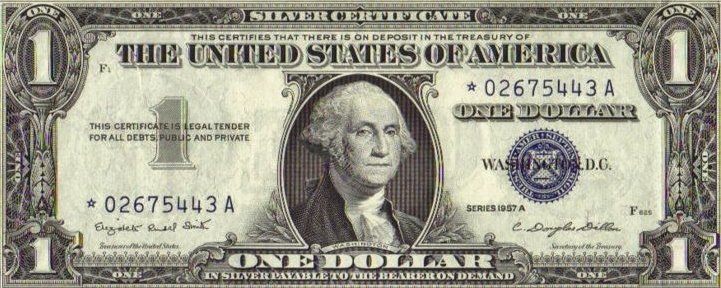

a 2010 person could convincingly roam the streets of 1948 America (although most would be bored to tears within 90 seconds).

To humorists of the '30s and '40s, the ways of the 18th and 19th centuries were a carnival of hilarity. The elaborate dress, the florid language, the courtly behavior, the rituals of social life, and the chaste nature of romance seemed alien, cornball and insufferable.

John Stanley trafficked in this trend of fun-poking at the past and its quaintness. He chose to go back to the 18th century. This ties in with popular culture's contemporary fascination with period dramas--in which the past is taken very, very seriously.

Novels such as Kathleen Winsor's 1944 Forever Amber were huge best-sellers in wartime and post-war America. In the 1940s, Hollywood was in the midst of a decades-long love affair with Ye Olden Times. Movies as diverse as Hangover Square and Gone With the Wind painted elaborate portraits of the lifestyles of yore.

Stanley chose the costume-drama era, rather than the Gilded Age, for his comic book spoofs. Like Perelman, Fields and Held, he emphasized the excess and needless courtliness of those bygone days. Stanley makes the same point in his spoofs: isn't this just too much? Why on earth did these people go to so much fuss and bother?

In New Funnies #99, his "Woody Woodpecker" story has the bird reading a book on the subject...

Woody has a more conventional dream sequence here, as you can see. He makes a burlesque of olden manners, including the gentlemanly art of the duel. He  humiliates his duel partner--and picks his pocket for good measure.

At story's end, Woody returns to consciousness, and the present. He addresses the reader, with obvious self-satisfaction:


This untitled story is quite amusing. It's loaded with energy, wordplay and wit. John Stanley was on the start of his learning curve as a writer in 1945. Two years later, he returned to this spoof-the-Gilded-Age turf in New Funnies. This time, he adds extra layers to the scenario. As with my favorite Stanley story, "The Guest in the Ghost Hotel," this story's occurrences walk the fine line between reality and fantasy. 

Notably, this story starts with rainfall--always an agent of change in John Stanley's world.


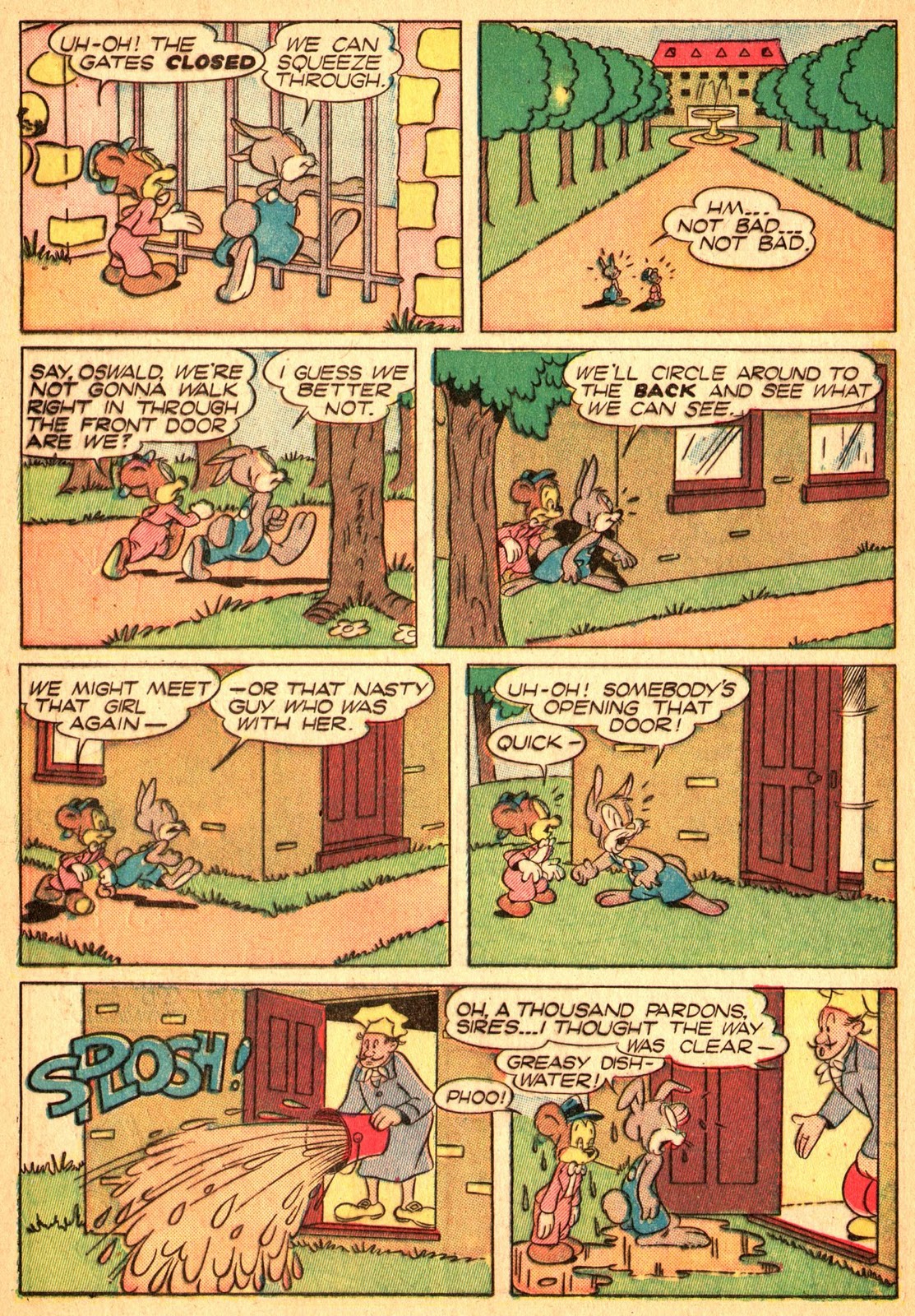


Loaded with clever humor, farcical action, and higher stakes than the "Woody" story, this "Oswald" piece benefits from twice the page count. Stanley has time to indulge his loves of wordplay and broad physical action. He sets up an elaborate, rather intellectual gag sequence (on pp. 4-5), in which the town crier includes an oral comics section in his news broadcast.

The Thurber-esque look of the male human characters is typical of Stanley's 1946 and '47 work. I would assume Stanley was an admirer of Thurber's. I don't know if the decision to sorta-ape Thurber's cartoon style was Stanley's, or that of the unknown artists who worked on New Funnies in this period. Whatever the case, there are many occurrences of faux-Thurber in Stanley's post-war New Funnies work.

Most noteworthy in this story is the transition from 1947 reality to that of the gilded past. There is no dream sequence signifier. The antique dueling pistols bring the cuddly duo to the past; a falling chandelier literally smashes them back to present-day.

It is the characters' dialogue--and their imaginations--that put them in this timeless state. Therein, they're free to act out, 1947-style, in a world they don't understand. Oswald and Toby are somewhat informed by the knowledge of the past they've picked up from costume-drama movies and whatever pop fiction they've ingested.

Of course, their standard-issue 1940s behavior now seems a bit quaint to us in 2010. This adds another, unintended layer to the story's functions.

Carl Barks achieved something similar in his 1951 story "Donald Duck in Old California." He, too, used something more than a mere daydream to transport his characters to a very real, solid past. Barks plays things much more straight than Stanley, but he also gets some comedy from cultural incongruity--from how much things have changed in 100 years.

The way Barks brings his characters in and out of the past is far more elegant and elaborate than Stanley's devices here. Of course, Barks had over twice the page length accorded Stanley in today's offering.

If you've never read "In Old California," which is among Carl Barks' greatest achievements in comics, you can peruse it on-line HERE. These two stories allow a rare window to intensely compare the storytelling styles of Carl Barks and John Stanley.

Though I still consider Stanley the superior creator, for many reasons, I don't deny Barks' skills as a storyteller or cartoonist. They came, literally, from different places--Barks from the Pacific Northwest and Stanley from the Northeast.

The approaches of these two stories are tellingly different in that regard. Barks embraces a specific, deeply felt locale, and renders it lovingly. In "Old California," the landscape is the unspoken star of the story.

Stanley, focused on his characters, merely sketches in a broad background and lets it function as a backdrop to the action. Historical accuracy is obviously not a concern of his. He gives the reader just enough to coast on, and lets his characters and their motivations run the show.

With this final thought, I'll seal the cork on today's missive, and toss it upon the vast waters of the Internet...

Tuesday, September 29, 2009

This One's For Trade & Son: Deceipt, One-Upmanship Causes Multiple Treks Thru' Rain; Kiddie Power-Play Inducts 2 Adults [Little Lulu #24, 1950]

Here at "Stanley Stories," we take requests. Not many folks have stepped up to the mike and asked for a particular story, so it's always a delight to get a nice note from our readership, with a query about a certain story.

Today's story is a special request by the talented cartoonist and story-teller Trade Loeffler, author of the web-comic Zip and Li'l Bit, which you can peruse by clicking HERE.

Trade also has a book coming out early in 2010 for RAW Junior's TOON Books imprint. We wish him all the success in the world--and in the comix world, extra wishes can't hurt!

Trade and son asked to see a classic "Little Lulu" story. I tend to shy away from Lulu stories that are currently in-print, via Dark Horse's trade paperback reprint series.

However, those stories from Stanley's classic late 1940s-mid '50s period, are not printed in color. Most newer readers of Little Lulu have never, and will never, see them as they were originally intended and as published.

As well, this story is peak Stanley work--a brilliant set-up, in which a single, innocent action is repeated, building in tension and humor with each reiteration, and through the richly developed personae of Stanley's "Lulu" cast.

It is, indeed, a rainy day here in Seattle--windy and cold, too. I'm feeling on the verge of illness. I've tried to work today, but have not gotten far. I think now is the perfect time for us all to enjoy a "Rainy Day."


It's mind-boggling to consider the consistent, almost dogged brilliance of John Stanley's Little Lulu. Issue after issue, one great story follows another. Rarely does the writing seem forced or compromised. Lulu seems effortless on its author's behalf.

It's easy to take such reliable, high-quality work for granted. But this body of comix deserves to be regularly recognized for its intelligence, creativity, and integrity.

These aren't just funny stories about comical characters. John Stanley added so much emotional and distinct shading to his work on Lulu.

He certainly didn't have to go to all this trouble. Little Lulu was, very likely, seen by Western/Dell as "good clean fun for the kiddies"--a popular licensed property that would attract readership on its reputation alone.

Certainly, many of Dell's other licensed-character comix were run-of-the-mill, at best. Look beyond Stanley, Carl Barks, Walt Kelly, Gaylord DuBois and a few other inspired creators, and Dell's output is, largely, lifeless tripe.

John Stanley seemed to really enjoy writing Little Lulu. He had given so much of an inner core to its characters--little more than stick-figures in Marge Buell's original magazine cartoons.

It's apt that Lulu was a shill for Kleenex tissues for many years. Her media, outside of the Stanley comix and a few of the early Famous Studios animated adaptations, are like tissue--simple, soft, and prone to collapse under scrutiny.

Like Barks' rethink of the Disney ducks, Stanley's Little Lulu adaptation brought rich character motivation and personality quirks to former stick-figures.

"Rainy Day" is a prime piece of sitcom, Stanley style. What makes this story funny is NOT just the motif of Lulu and Tubby missing each other as they trod, back and forth, in the rain to each others' homes.

It's the war of wills between stubborn Lulu and ego-maniac Tubby--archetypical yin and yang characters, who both need one another and repel one another, like identically charged magnets--that helps this simple scenario build to a delightful crescendo.

Lulu and Tubby's duelling determination to manipulate one another into doing things their way soon sucks in their mothers, who join the ping-pong match to and fro, from the Moppet residence to the Tompkins'.

For once, Lulu is also inducted into Tubby's mindset. Sensing that Tub is fibbing about his >sniffle< cold, she fakes a considerably less convincing illness. Beautifully, as the inexorable story-wheel turns, Tub forgets that Lulu was an obvious faker--he buys into the exact style of deception he deals.

Finally, the kids' mothers worry, understandably, that their kids might be catching a cold from all those trips through the rain. Lulu and Tubby end up having sort-of fun when they realize the extent to which their mothers have been drawn into this deceptive scheme.

Typical of his peak-period work, Stanley ends the story on a double-edged kicker: the skies clear up, and Lulu and Tubby decide to initiate a new wave of back-and-forth. We don't see them leave, and we don't need to. It's just the thought that they've learned nothing from their recent experiences that gives "Rainy Day" its boffo closure.

Trade and son, I hope you enjoyed reading this fine story in full color. Ditto to all you other fine Stanley Stories followers!

Monday, February 23, 2009

Yow! A Stanley Surprise from Our Gang Comics #47, 1947

The thing that really hooks me about John Stanley's work: there's so much of it, and it's hiding between the cracks of comix history.

I half-heartedly peruse various Dell Comics titles from 1946-1956, in search of tell-tale story elements... quirks... themes... that signify a Stanley Story.

Much of this time is wasted--but perhaps none of it is in vain. When I discover a story such as the one you're about to read, all that dutiful perusing pays off.

I had no idea that John Stanley returned to writing "Tom and Jerry" in 1947/8. It makes sense, and solves a mystery. Stanley abruptly left his four-year tenure on Dell's New Funnies title in 1947. How did he manage it?

His long-term gig in Little Lulu was established by this time--it seemed clear that Lulu was going to get her own title.

By 1947, Stanley often wrote 32 pages of content, per issue, on New Funnies. It represented a substantial loss of income for him to leave that title.

In 1946 and '47, Stanley seemed determined to establish himself as a writer-cartoonist. He illustrated several "Woody Woodpecker" stories for New Funnies, and began his "Jigger and Mooch" series for Animal Comics. He would try once more with "Peterkin Pottle," for Raggedy Ann and Andy in '48 and '49.

During this period, Stanley had at least one cartoon published in The New Yorker. A cartoonist could hardly do better; that's as upscale as it gets. I've recently learned that Stanley may have also written some gags for other New Yorker cartoonists. Next time I get to New York, I'm going to research this further.

It could be that the work on The New Yorker bolstered Stanley's income. I'm sure they paid much better than Dell. Even the writing of gag concepts probably gave Stanley more $$$ than his work on a 10-page comic-book story.

Drawing his own stories gave Stanley some pleasure and satisfaction, I'm sure. His work at Dell had often been indelicately rendered by staff artists--some great, some bad, most of them merely competent.

Stanley's Thurber-inspired cartooning style, with strong elements of 1940s animation, became slick via his '46-'49 comic book work. I still haven't seen his New Yorker cartoon, but thanks to Jeet Heer, I've learned its publication date. I'll find the thing and post it here ASAP.

Stanley had the smarts and the skill to make it as a magazine cartoonist. Perhaps he preferred the relative freedom of the Dell titles. They gave him a large playpen, with seemingly stern rules that were seldom enforced.

Furthermore, by assuming the responsibility of the monthly Little Lulu book in 1948, Stanley became a great storyteller. LL gave Stanley the discipline and the sheer experience that he needed to refine his art, take risks, and develop the already-strong techniques and narrative ideas he had already shown to the world.

This remarkable story comes from 1947. I assume that Stanley picked up the "Tom and Jerry"-related features from Our Gang Comics to make up for the loss of the steady New Funnies gig. He had written T&J from 1942 to '46, and had established his take on the licensed characters.

Yesterday, I posted two 1945/6 T&J stories. They're fine pieces. They suffer somewhat from the cramped wartime format, when Dell's 64-page comix went, without warning, from 60 to 52 to 36 pages, as paper allotments permitted.

All of Dell's auteur cartoonists suffered from this crunch. Carl Barks, Dan Noonan, Walt Kelly and others were forced to abandon the spacious, sunny, open feel of their earlier work, and compress stories into relentless 12-panel grids, reminiscent of the Fox Comics titles of 1939.

Some of these stories were obviously cut-and-paste reductions of longer stories. Some of Barks' short "Donald Duck" stories bear obvious evidence of a hasty reformat.

Dell stuck with the four-tier format for most of their humorous titles after the wartime restrictions eased. Their comics still veered between 52 and 36 pages, so it made sense to stick to this more flexible format.

I think these wartime rigors also helped hone Stanley's skills. By 1947, his writing had a new sharpness and compactness.

The difference between the story you're about to read, and those I posted yesterday, is striking.

Stanley completely dispenses with Tom Cat in this 10-page story. He takes risks with his self-imposed T&J format by making Jerry, ordinarily the voice of reason, more prone to taking chances.

We're in the urban Anywhere of Stanley's Little Lulu stories. And, better yet, Stanley uses one of his pet LL devices--little wind-up mechanical men. In the John Stanley universe, there is always a sweaty, disreputable street vendor, his display case hastily opened on a side-street, his little wind-up men on temporary display, until a cop, munching a stolen banana, puts a stop to his free enterprise.

I think this story's use of the wind-up men pre-dates any appearances in Little Lulu--tho' I could be wrong. This could be one of those birth-of-a-notion stories.

Regardless, this is a beautiful story, rife with vital Stanley themes and peppered with his lovely use of language. The business with the raindrops, towards the story's end, achieves a kind of comixmatic poetry. I was tickled pink to spot this story, and am equally giddy to share it with you.

There are more, too! They'll show up here. And now, I shall, pardon the pun, wind up my spiel and raise the curtains...