To choose the best of John Stanley's un-reprinted stories is a bittersweet affair. Most of these stories will remain un-reprinted, due to their characters being owned by greedy megacorps. These conglomerations generally won't bother unless they're guaranteed megabucks. Otherwise, materials that feature their copyrighted properties languish in limbo, known only to nuts like myself who bother to shed light on them.
The good news is that
some of these choices
will see the light of reprint, in time. The 1940s and '50s licensed-character material of John Stanley, with the exception of
Little Lulu and its satellite titles, has stayed in the dark since its first (and sole) comic-book publication.
The freedom that Stanley took with these characters may have doomed these stories. Stanley retooled the characters, gave them tangible personalities, and had them do things that would have been way, way off-base for their standard print and screen versions.
That Stanley's re-imaginings of these licensed entities far outshines their official versions is a blessing for us, who enjoy this work, but a hindrance for modern-day attorneys and CEO-types who want to maintain a bland, wholesome mainstream image for their holdings.
Universal Media will never do anything with Andy Panda, but I'll bet they'd cringe at the idea of Andy threatening his room-mate with death. Ditto for the struggling, opportunistic loner who is Stanley's Woody Woodpecker, the garrulous, philosophical mice in his version of Tom and Jerry, and the equally verbose, self-absorbed take on Otto Soglow's The Little King.
This list will exclude any "Little Lulu" and "Tubby" stories. Those will all be reprinted within the next few years. Ditto for
Stanley's Thirteen Going on Eighteen, Nancy and
Melvin Monster. I cannot exclude the yet-to-be-reprinted
Dunc 'n' Loo, which Drawn + Quarterly will, in time, return to currency.
Thus, most of these picks will be from the 1940s and '50s. My criteria for these stories is not their date, but their content. I believe each of these ten pieces shows a side of John Stanley at his best and most inventive as a writer and/or cartoonist.
As before, if I have overlooked one of your favorite pieces, please interact and let me know. I'll be glad to update this list with your suggestions.
And now, in no particular order...
<><><><><><><><><><><><><><>
"The Secret Six" (Dell Four-Color #67, 1945)
Funnybook terrorism, condemnation of the super-rich, and cuddly funny animals combine in John Stanley's first major long comics narrative.
This particular issue is a John Stanley career milestone. Its two stories feature Stanley's first supernatural character (a proto-Witch Hazel) and the first of his Evil Rich.
The antagonist, D. J. Rarebit, is a wartime Dick Cheney--a business tycoon whose corporate knavery has endangered his life.
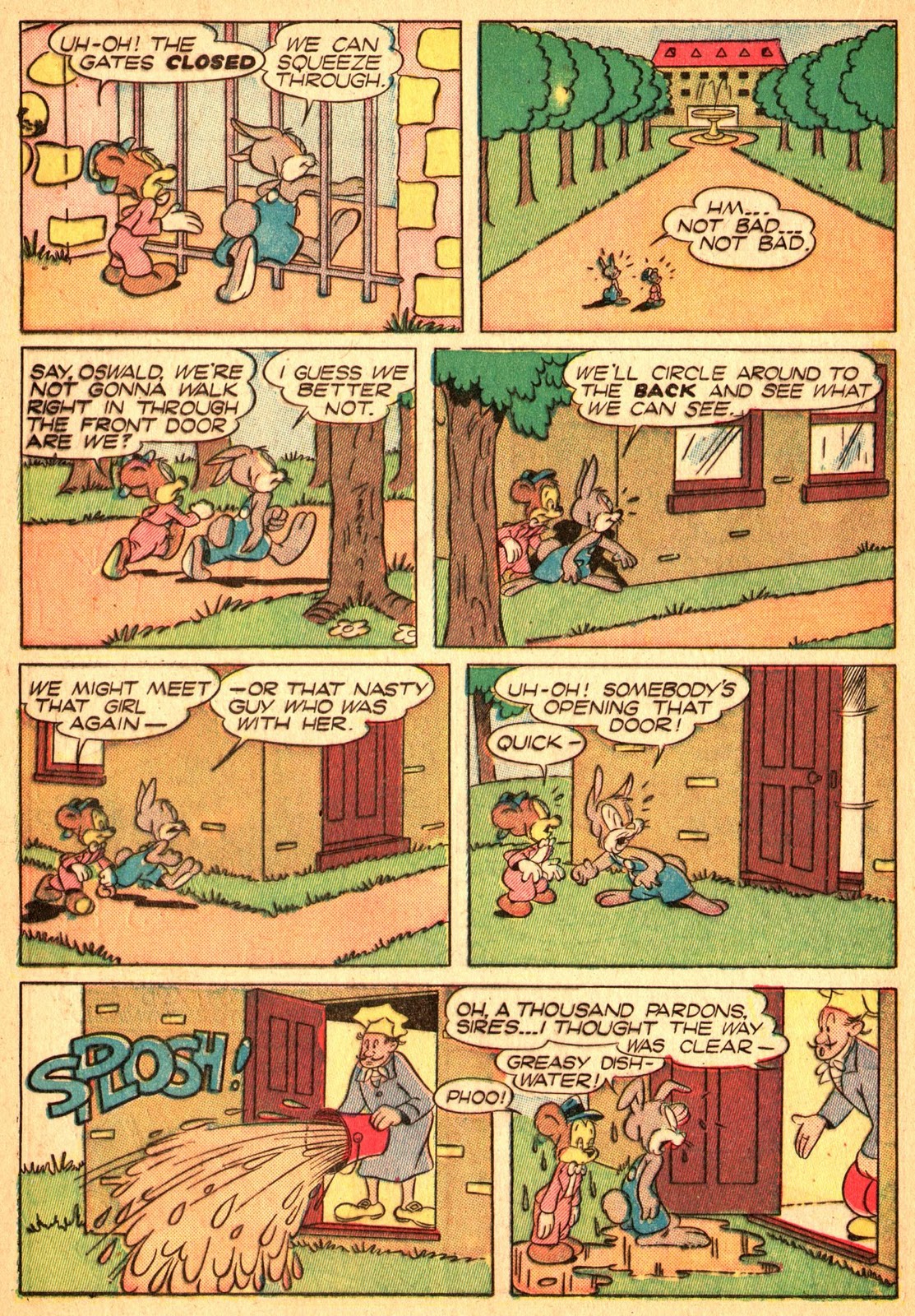
Gentle, kindly lookalike Oswald the Rabbit is hired to double for Rarebit, unaware of the darker dealings of the scion, or of his hit-list status.
By simply treating Rarebit's broken staff with fluffy good will, Oswald brings joy to a joyless world. In one of Stanley's most Frank Capra-esque sequences, Rarebit's rattled staff rejoices in being regarded as sentient beings with feelings and needs.
The darkness of Rarebit's fate soon displaces the fuzzy wuzzy funtime of Oswald and his playpal/partner Toby Bear. Ultimately, fate deals a karma-coated dose of justice to Rarebit--of which Oswald and Toby are only vaguely aware.
"The Secret Six" is quite complex, and takes genuine risks with its licensed properties and with the whole notion of "kiddie comics" and their air of harmless fun. This is storytelling with real cojones, and it deserves to see the light of day.
"Oswald the Rabbit" (untitled, Walter Lantz New Funnies #124, 1947)
John Stanley achieved a droll blend of slapstick and sitcom in his later stories for the long-running Dell title
New Funnies.
By 1947, his last year on the title, the sophistication and strong humor of Stanley's work in
New Funnies was quite striking.
The narrative stakes-raising that propels Stanley's
Little Lulu was born in the pages of
New Funnies. As well, a genuinely loopy, unpredictable sense of absurd humor is present.
In this, one of John Stanley's wittiest and funniest stories, Oswald and Toby have their domestic bliss shattered by the neurotic magician The Great Marvo.
Marvo honors Toby's bizarre request to become a... well, I don't wish to spoil the surprise if you've not read this story. I don't think anything wackier has even happened in the pages of a mainstream comic book. Snappy artwork by Dan Gormley sells Stanley's sizzle and narrative stakes 100%.
Once again, this untitled story transcends the expectations of "kid comics" by miles and miles. I regret that this vein of absurd humor gradually ebbed from Stanley's work in the 1950s.
John Stanley's "Woody Woodpecker" one-page gags, Walter Lantz New Funnies #121-131, 1947
Eighteen filler gag pages, written and drawn by John Stanley during a period when he pursued a berth as a cartoonist-writer with Western Publications; a red-hued catalog of Stanley's growing sophistication as a cartoonist--and as an effective storyteller and humorist.
I am certain Universal Media would nix these pages, for several reasons. They go off-model with a vengeance, and Woody is given to vividly anti-social behavior in several of the 18 (including this, the first of the run).
These gag pages show the apparent influence of the great cartoonist Milt Gross, plus some echoes of the brilliant theatrical cartoons of Tex Avery and Chuck Jones. There's even a touch of James Thurber (as is common for Stanley's 1940s cartooning).
You can see the entire run at the link above. These rival that famous hell-bound snowball in terms of being reprinted. 'Tis a pity, but that's the way it is.
 Around the Block With Dunc And Loo/Dunc and Loo (8 issue series, Dell Comics, 1961/3)
This is not a Draconian choice. It comprises some 280 pages of comics, all of it brilliantly brought to life by cartoonist Bill Williams.
Dunc and Loo is, by far, the most appealing of John Stanley's original comic book creations. Though it lacks the emotional depth of
Thirteen Going on Eighteen, or the dark dysfunction of
Melvin Monster (qualities that define and distinguish Stanley's 1960s work for many of his admirers),
Dunc is easier to embrace.
Its connections to the urban worlds of Stanley's 1940s funny-animal stories, to Little Lulu, and to Stanley's curious take on Nancy and Sluggo, makes
Dunc and Loo perhaps more palatable than Stanley's later work.
Stanley was blessed with the collaboration of Bill Williams. They'd first worked together in 1950 on Dell's
Henry Aldrich comic book series. Stanley and Williams worked up some unsold newspaper strip concepts (shared with us by Stanley's son James in
THIS post) which ultimately became part of the D&L universe.
Status comedy, stakes-raising, down-to-earth narratives, social embarrassment, broad but appealing characters (akin to those in Nat Hiken's vigorous TV sitcoms
Sgt. Bilko and
Car 54, Where Are You?) and a well-defined, slightly claustrophobic lower-class urban landscape all distinguish
Dunc and Loo.
Stanley's prior experiment in the teen-humor genre, the two-issue
Kookie, can be lumped in with
Dunc and Loo's eight issues. A Max Shulman-esque, farcical look at the Greenwich Village world of espresso houses, beatniks and art chicks,
Kookie (also with superb cartooning by Bill Williams) was given the ax before it even had a chance to breathe.
Kookie is a strong improvement over the occasionally brilliant but uneven
Nancy and Sluggo. Perhaps its characters were too out-there for 1961 readers. With
Dunc and Loo, Stanley found his niche as a teller of sophisticated, bright sitcoms on paper. Peppered with creative uses of typography, clever yet utile page layouts and boundless energy, D&L ranks among John Stanley's finest work in comics.
Due to an eventual reprint volume by Drawn + Quarterly, I've held off on running many stories from this series here. If you haven't prowled around this blog too much, I'll be a sport.
This link takes you to a
Kookie story;
these 'uns will land you in Dunc and Looville.
The Little King (three Dell Four Color one-shots [494, 597, 677], 1953-56)
The 1950s were John Stanley's most even-tempered years as a comic book creator. The enormous success--and responsibility--of his tenure on Marge's
Little Lulu and
Tubby caused Stanley to power down on his wilder impulses as a storyteller.
Little Lulu was just right for post-war America. It had just enough brass, sass and personality to become a mainstream smash. Simultaneously, its characterization, narrative stakes and linguistic richness brought out Stanley's best as a writer.
Lulu was series fiction, run by a number of formulae. By 1953, Stanley simply filled in the blanks on a set of story templates (Lulu tells Alvin a story; Tubby tries to woo Gloria/trick Lulu/frustrate Wilbur; Tubby solves a 'crime' in the Moppet household; Tubby torments the universe with his bad violin playing).
What might have been cynical hackwork became richly nuanced, solidly character-driven mainstream storytelling of the highest order. It took a mix of discipline and innovation to run the good ship
Little Lulu, as Stanley did for thousands upon thousands of never-phoned-in pages.
This discipline applied to the smattering of non-
Lulu comic book work Stanley achieved in the 1950s. The finest, by far, are the trio of one-shot comics featuring Otto Soglow's King Features Syndicate-owned entity "The Little King."
As he did with most copyrighted properties in his path, John Stanley took the good aspects of Soglow's set-up and characters, tossed out the rest, and modeled it to best suit his strengths as a storyteller. Stanley's Little King is endowed with the classic quirks of what I call "the Tubby type." I've written extensively about this character archetype
HERE, and don't wish to repeat myself.
Among the best of these stories is "The Search," which may be found in the link embedded in this entry's title. Stanley mines great comedy out of one character's quest for the inconsequential, and creates a strong character-based story arc that resolves plausibly and charmingly.
"Raggedy Ann and Andy" (untitled story, Raggedy Ann and Andy #36, 1949; story and art by John Stanley)
Among the most curious of Stanley's comics assignments were the handful of "Raggedy Ann and Andy" stories he wrote and drew in 1949. Simultaneously, Stanley also wrote and drew his original creation, "Peterkin Pottle," for the magazine.
The Munchhausen-esque Pottle took the cover and lead spot in the
Raggedy Ann comic book for seven issues. Hidden inside their own magazine, Stanley's "Raggedy Ann" stories are a final burst of wild imagination before the restraint and control of his 1950s work.
These stories presage what would be Stanley's lone outpost of freeform fiction in the '50s--those improvised fairy tales, told monthly to bratty neighbor Alvin by long-suffering Lulu Moppet. Stanley delivered these stories like clockwork, issue after issue. All of them contain at least one brilliant narrative concept. At their best, they tackle dark themes adroitly and pursue sky-high narrative stakes.
That said, the protagonists of these fairy-tales never
died. In this jaw-dropping "Raggedy Ann" story, the two sentient dolls consume poison mushrooms and expire. Their misadventures in a defective, mischief-riven Heaven bring them back to life on Earth, none the wiser for their ethereal exploits.
All of Stanley's "Raggedy Ann" stories are fine, and a few, this included, show him at his best as both artist and writer. This story's treatment of death, afterlife, and resurrection is, I believe, once again unique to mainstream comic books.
I'm sure that Hasbro, Inc. and Simon and Schuster, the current owners of Johnny Gruelle's Raggedy characters, would heartily disapprove of the concept, execution and publication of this 1949 story in 2010.
O. G. Whiz #1 (Gold Key Comics, 1971)
John Stanley's final work for comics,
O. G. Whiz offers one final dose of his intense, verbose, intelligent comedy and storytelling.
Had Stanley not soured on further work in the comics field,
O. G. Whiz might have been a final successful run for him as a creator. Its concept is brilliant (and entirely original). The stakes, density and zaniness of the four stories here are rich and inspired.
James Stanley has mentioned that his dad was fond of some of the underground comics of the 1970s, and that he was a regular reader of the classic
National Lampoon comics section of the era.
There seems to me to be a strong connection between late Stanley and the best work of underground writer-artist Gilbert Shelton. Whether this is coincidental or not, this likeness is particularly strong in these last four comic-book stories of John Stanley's long career.
You can read the entire contents of this final Stanley work
HERE and
HITHER.
"Woody Woodpecker" (untitled, New Funnies #93, 1944)
Among Stanley's first comic book stories is this vivid, harrowing nightmare narrative.
As in "The Secret Six," dark, threatening imagery runs rampant here. The uncredited cartoonist does beautiful work here, and brings the frightful, accelerating dream-narrative of the addled bird to full life.
This story also introduces the truant officer to John Stanley's world--ultimate threatening authority figure to comic book children of any genus.
Among several outstanding "Woody Woodpecker" stories written and illustrated by Stanley in 1944, '45 and '46, this is a peak effort. You can read it
HERE. Several other '40s Woodpecker stories are salted throughout this blog.
"Tom and Jerry" (untitled, Our Gang Comics #47, 1948)
Tom and Jerry was the first series John Stanley wrote for comic books. He did two runs on this series. In the first one, which spans from 1943-45, we see him developing as a comics writer.
Towards the end of that first run, Stanley hits some homers. The starkness, vividness and general impact of his storytelling, characterization and comedy sense makes a quantum leap in these early efforts.
Stanley returned to "Tom and Jerry" in 1947 and '48. His growth as a writer, and his rich ability to write from well-wrought characters, is strongly felt here.
This story is, notably, free of the character of Tom Cat. As with many of Stanley's "Tom and Jerry" stories, the conflict-based, violent attitude of the Hanna-Barbera cartoons is discarded. Stanley is far more interested in the two mice, and in their Quixotic explorations of the big world of human beings.
A quiet poetry emerges in this untitled story, which is written with sharp wit and great charm. The uncredited cartooning, which may be partially by Harvey Eisenberg, shines as well.
Because John Stanley's "Tom and Jerry" stories take such particular liberties with the flawed premise of the original, I doubt that whomever currently owns the property would feel these stories were worthy of reissue. Several strong examples of Stanley's "Tom and Jerry" can be found in this blog.
Read this story
HERE.
John Stanley's New Yorker gag cartoon, printed in 3/15/1947 issue
The sale of this gag cartoon to
The New Yorker, acme of the cartoon market in the 1940s, was John Stanley's most prestigious career moment. Why he didn't do more for the magazine remains one of the unsolved, unanswered mysteries of his life story.
This piece has been reprinted (horribly) in
THIS highly flawed book. Thanks to the sharing of a high-rez scan by Drawn + Quarterly's Tom Devlin, you can see Stanley's melancholy cartoon
HERE on this blog.
I can think of another dozen or so stories I'd put on this list, but I promised I'd stop at 10. If mega-corporations could approach this work with a sense of its artistic worth, rather than how it conforms to current versions of the characters, and allow them to be reprinted for affordable, humane fees, much of this hidden work of John Stanley's would make for a great anthology or two. (Hire me to co-ordinate and write it, won't you, kind publisher?)